Hey Denny !
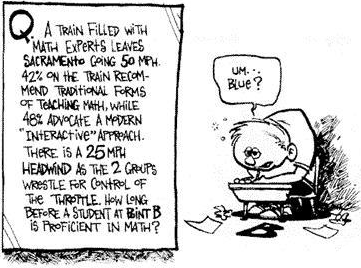
Sum a string of zeros and you don’t get zero. New math?
New Math … you must show your work.
Rich (haywool) who does NOT admirer this new math stuff
Hey Denny !
Sum a string of zeros and you don’t get zero. New math?
New Math … you must show your work.
Rich (haywool) who does NOT admirer this new math stuff
You don’t admire this?
http://knepfle.com/mathcomics/new_math.gif
I love this one!
http://davidmurodesign.com/blog/wp-content/uploads/2009/04/n…
The Captain
no dollar ever comes out of the market into an investor’s pocket that didn’t go into the market from another investor’s pocket…
This is simply false, and from a false premise comes an entire false argument.
LOTS of money comes out of the market which never came from another investor’s pocket.
It’s called “Dividends”, which is money that came from consumers buying a product or service, making a company profitable, and then having the company distribute those profits (which I point out, again, did NOT come from investors, but from consumers) back to the owners of the company, aka stockholders.
Money is constantly flowing to shareholders which did not originate with other shareholders. How did everyone miss this?
Hi Goof,
The essay the quote comes from did indeed mention dividends (positive sum) as well as brokerage fees (negative sum) as “leakage” to the strict definition of a zero sum. So to the extent these events skew the game, it is clearly not zero sum. I wonder what the ratio of total fees to dividends paid is? Also, there are many stocks that will never pay a dividend, and investors are still happy to pay a high price for them. For the most part, the stock market is a “money in, money out” game, though is still a game worth playing.
DT
many stocks that will never pay a dividend, and investors are still happy to pay a high price for them. For the most part, the stock market is a “money in, money out” game, though is still a game worth playing.
Consider this. You buy a stock for $10. Later you sell for $100. Both transactions in isolation are ‘zero sum’, but the system as a whole is not - $90 of wealth has been created. It is not dividends that make the difference, they just help to highlight the fact that overall the value of the market is increasing.
Ian
The essay the quote comes from did indeed mention dividends (positive sum) as well as brokerage fees (negative sum) as “leakage”
I have a hard time describing something that contributes 40% of the market’s value as “leakage.”
Going back over the past 80 years, dividends have accounted for more than 40% of the total returns of the S&P 500.
http://www.dividend.com/dividend-education/40-things-every-d…
That is a quite substantial percentage, and if casinos can make it on the house’s “minus 2%”, then something that flows “positive 40%” into the market from external sources (corporate profits), it hardly seems appropriate to use a word like “leakage”, does it?
As for fees, that is a tough comparison. You can fee up all you want: rake off unnecessary marketing fees, add loads to either front end or back end or both, do the “2 and 20” of hedge funds, or simply churn, churn, churn. Heck, you can eat up 100% in fees if you like (and we have all read news stories of unscrupulous brokers who have done so.) On the other hand, putting the money in an S&P ETF and comparing the 0.5% fee against the 40% addition of corporate dividends over time, it seems no comparison and that there is no “zero sum” argument to be made - unless the investor is so stupid as to ignore the effect and piss away the ex-market dividend gains with unnecessary transaction costs.
Lets not forget inflation.
Also, when you bought, did you buy from someone who sold their shares or from a short seller? Lots of considerations.
Ok, enough devils advocate for me. Let’s get back to stocks
So, we lost value when BOFI stock tanked. Can we gain that value back by responding to the trolling lawyers? Zero sum I’ll betcha.
Jim
no dollar ever comes out of the market into an investor’s pocket that didn’t go into the market from another investor’s pocket…
LOTS of money comes out of the market which never came from another investor’s pocket.
It’s called “Dividends”, which is money that came from consumers buying a product or service, making a company profitable,
Well, maybe, dividends after all are a distribution of capital which is reflected in share price. In a “perfect world” a $1/share dividend is reflected by a $1/share reduction in share price, IRL the relationship isn’t one-to-one. Thus the long discussions (on other boards) about the advantages and disadvantages about receiving forced capital distribution via dividends verses choosing when the receive the capital distribution by sale. (No intention to restart the discussion here, just noting it has been discussed.)
Any underlying increase in share price is generally also driven by real current or perceived future income which is the same source of dividends.
So, dividends and share price generally come from the same source, if one is outside money, then so is the other. In one isn’t neither is the other.
Jack
Goof writes:
I have a hard time describing something that contributes 40% of the market’s value as “leakage.”
Going back over the past 80 years, dividends have accounted for more than 40% of the total returns of the S&P 500.
Well, I have a hard time describing 40% of the total returns of the S&P 500 as 40% of the markets value.
A market’s return is certainly not the same thing as its value.
The S&P 500 is certainly not “the market”. Losers are continually replaced by winners in the S&P 500. The entire New York Stock exchange is closer to a market.
The negative sum from fees are transactional fees that occur at each stock trade, and happen millions of times a day. All the rest of the fees you refer to are outside the zero sum game. I suspect that total transactional fees taken from investors for all trades in a year are much greater than the dividends paid out. The S&P500 is now paying 2% dividend yield. Who knows what the dividend yield for the entire market is, but I’m sure it is much less than 2%.
Ian,
When you bought the stock for $10, someone sold it to you for $10. Ten bucks in, ten bucks out. When you sell the stock for $100 someone buys it from you for $100. Money in money out. He may later sell it for $1000 or $1. No wealth is being “created” or “destroyed” in any of these transactions. The first investor has simply taken $90 profit from the game at the next investor’s expense. This may be a good or bad deal for the next investor depending on how things go for the company down the road, and when he chooses to sell his stock.
DT
Who is done flogging this dead horse and will return to trying to figure out which stocks should be bought and sold in the market as it exists today.
When you bought the stock for $10, someone sold it to you for $10. Ten bucks in, ten bucks out.
Sigh. But the stock paid 5% dividends (MO, for example, number picked for convenience). So a year later you sold the stock for $10, but meanwhile you have pocketed 50¢. When you sell it for $10, you now have $10.50. $10 came from “another investor.”* The rest came from users (customers), NOT from investors.
Ten bucks in, $10.50 out. Not zero sum.
Hold it for 10 years, ten bucks in, fifteen bucks out. Fully half the gain NOT from investors*. This is why the market is not “zero sum” as it is being thrown about in this thread.
(*example presumes absolutely no “stock gain” during the 10 year time period. That’s not generally how it has worked, but that’s irrelevant to the example.)
When you bought the stock for $10, someone sold it to you for $10. Ten bucks in, ten bucks out. When you sell the stock for $100 someone buys it from you for $100. Money in money out.
I know I’m an idiot to keep trying to explain this. Some people just have a blind spot. But I’ll try one more time. And I’ll really try to quit.
For simplicity let’s say the “market” we are talking about has just one company in it. that shouldn’t make any difference to value creation. Lets say the company is worth $10 million. It has 100 shares of stock. You buy 100 shares of stock for $10 million…the whole company.
The company does really well over five years and has grown like mad, has grown ten times as big in fact, and is now worth $100 million dollars. You sell your 100 shares of stock for $100 million… the whole company.
ARE YOU TELLING ME NO VALUE HAS BEEN CREATED IN THIS COMPANY? WHICH IS THIS MARKET?
BECAUSE SOMEONE ELSE HAS COME ALONG AND BOUGHT IT??? WHAT DOES THAT HAVE TO DO WITH VALUE CREATION???
The company (the market) has grown 10 times in value for God’s sake!
That’s it. I quit.
Saul
Hi Saul,
Thanks for humoring me and my blind spot. I think we are just talking semantics here. For example, what is the true meaning of creation?…. Uh just kidding, that’s an entirely different discussion that might get really long!  And I’m not trying to hassle you or be difficult. I just find this discussion interesting, though my take is clearly in the minority here.
A market and a company are just not the same thing Saul, even if there is only one company in the “market”. A market is simply that. It is a “place” (real or virtual) where trades happen and are governed by a set of rules defining how those trades occur. That is all a market can do - conduct zero sum trades. It can’t add to or subtract from the value of anything that is traded within that market. This single company that makes up your market can indeed increase or decrease in value, and the price at market may or may not reflect that value accurately. But the “market” is still a zero sum game. When you buy the hypothetical company in your market, you pay $10 million dollars for all the stock. But you pay that $10 million to the previous owner who then takes the money out of the market - money in, money out, zero sum. Five years later, you sell your shares for $10 million dollars, but SOMEBODY has to give you $10 million for your shares. He puts his money in, you take your money out - zero sum.
THE ONLY WAY THAT WEALTH CAN BE DERIVED FROM A MARKET IS TO TAKE MONEY OUT THAT HAS BEEN PUT IN BY SOMEONE ELSE.
Isn’t that pretty darn close to the definition of a zero-sum game?
(I know, I’m ignoring dividends and transactional fees, Goof)
So to answer your question:
ARE YOU TELLING ME NO VALUE HAS BEEN CREATED IN THIS COMPANY? No I am not. That is exactly where the value is created.
WHICH IS THIS MARKET? No, the company is not the market! If you want to realize the value that the company has created, you need to sell your shares and get out of the market.
Contrast this with a privately held company. As a private owner, I can use the company funds to do anything I want - buy a car, boat, house, whatever. It is my company. But if the company is in the market, it is publicly held and I need to follow the rules.
Maybe my “blind spot” is a result of my profession - a structural engineer. One of the first things I learned is that for a given structural system, the summation of forces must always equal zero. It doesn’t matter whether you add to, take away, grow things on top of, or anything else within the system. The total summation of forces must always equal zero. Force in, Reaction out.
OK, I’m tapping out.
DT
Isn’t that pretty darn close to the definition of a zero-sum game?
No. Take one company with 1000 shares which originally sell for $100. The company grows and someone decides to sell one of those shares and finds a buyer at $200. Now, there are 1000 shares valued at $200 and only $100 more cash got put into the market.