Nobody here is making an argument that multi sensor won’t work. The only argument that I am making is reiterating Tesla’s position as to why they are pursuing vision only as the solution. Along with that, I am pointing out the measure of success is two fold. 1) a system that work reliably and safely
a system that can at scale operate profitability and with the potential of a moat.
It’s not. It’s still an ADAS system. It can’t drive itself - it requires a human driver behind the wheel ready to take over when the system disengaged. It’s a very good ADAS. It may very well be the best ADAS in the world. But it is still an ADAS.
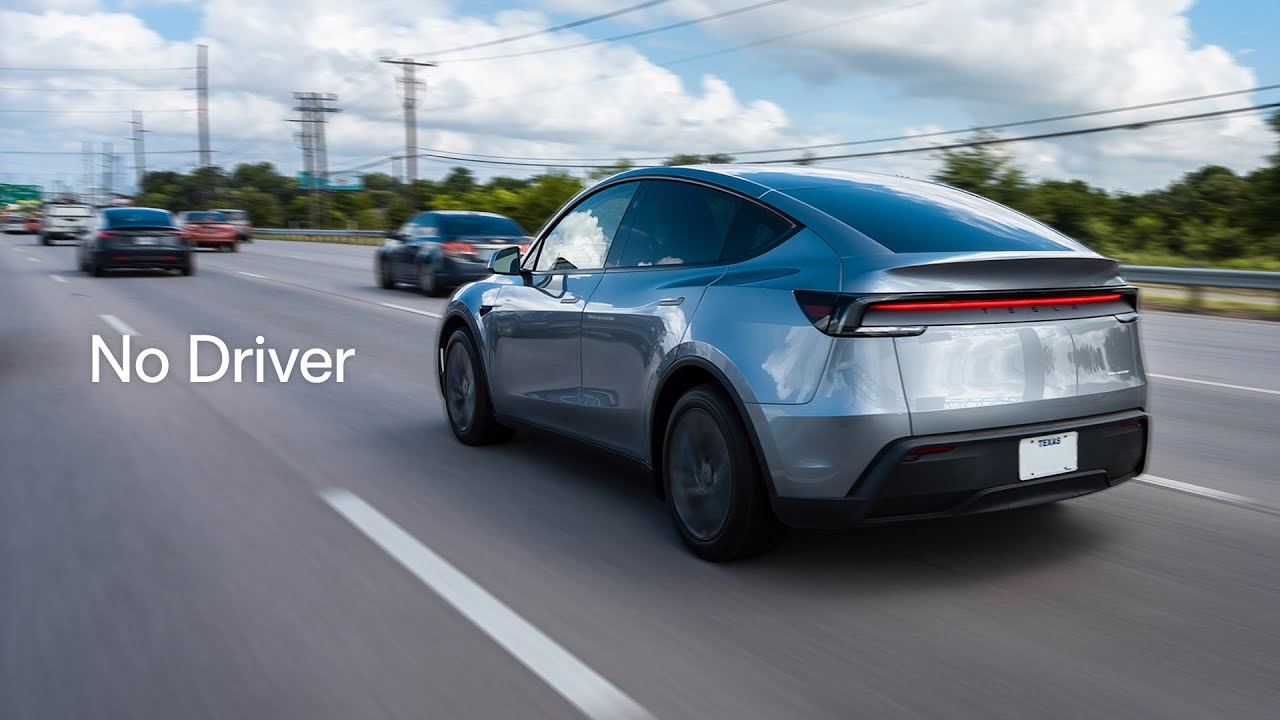
What Tesla is deploying in the robotaxis is a modified version of FSD, and they are trying to get it to work as an actual autonomous driver. But they haven’t been able to scale it, because they still have safety issues. That’s why there’s barely a few dozen actually autonomous cars in Tesla’s taxi fleet. The overwhelming majority of them are just taxis with humans sitting behind the wheel in California. The slight majority of them elsewhere have human monitors in the passenger seat (as of recent reporting).
Once Waymo hits a big enough fleet to justify it, it will be trivial for them to contract with an automaker to manufacture cars that have their sensor suite as OEM. The fact that Tesla makes its own cars is not a durable advantage. The fact that Tesla doesn’t use LIDAR was an advantage back when LIDAR was really expensive - if the sensor rig itself requires a vastly more expensive component than vision-only, that delta in cost doesn’t disappear when Waymo shifts from artisanal after-market crafting into mass-produced OEM cars. But that cost differential has disappeared. It just has taken Tesla too long to make vision-only work, LIDAR and high-def radar innovated too quickly, and now their ostensible moat has vanished.
No there are two arguments being made. I would go back re-read thread. 1) is the above stated argument 2) the other is that the long term cost differential of evenual mass production and operation is negligible. It right there in the quote I provided.
But Tesla’s position was that they were pursuing vision-only because multi-sensor systems presented safety problems in integrating the different sensor feeds. That has been disproven. What do you think Tesla’s position on vision-only was that did not involve skepticism that multi-sensor could work?
Sure, except perhaps as to the last bit. Lots of industries exist where participants don’t have a moat.
But that’s not really responsive to the point of the Waymo presenter. This point isn’t a claim about whether Waymo will be economically successful. It’s an argument about whether a vision only system can meet your first requirement, whether it can “work reliably and safely.” Waymo failing economically doesn’t mean that Tesla’s approach to FSD can actually produce an autonomous system using only vision.
Not an argument I was making. But I will agree that the delta in cost differential between the two due to LIDAR is negligible, since the cost of LIDAR has fallen so sharply. A few LIDAR components in a car will add less than $1K to the manufacturing cost of the vehicle. That doesn’t mean that Tesla’s manufacturing costs won’t be lower than Waymo’s, because Tesla is planning to use a super-small two-seater instead of a standard sized sedan. The overall cost of such vehicles will be lower, because it is much cheaper to produce a tiny car than a full-sized car. But that won’t be a product of the sensor choices.
Tesla made a multi faceted argument that won’t bother to re-hash here. The head of design stated as to safety, they believed, beyond the massive requirement of compute, it could create a bottleneck in terms of reaction times. The reaction time delay could be fractions of seconds. It was not say that multi sensor could not work or the integration issue solved. Until Tesla solves vision only, we just don’t know, in these more unique situations, how the approaches compare. It is entirely possible both meet safety standards, for mass commercialization and are far superior to human drivers.
Who said they don’t? I am an investor that wants to own a business with a potential moat. So, it is a consideration from my perspective. It needs to be a core part of my thesis for investing. I have zero interest in a commodity type investment, which may be the fate of this entire sector. Google is famous for spending wildly on side ambitions that have never produced anything substantial for the business. It’s a luxury given the core margins of its primary business.
Again, you are doing exactly what you claimed wasn’t occuring in an earlier part of the thread. You are distilling down the manufacturing and operational costs to a few bolt on pieces. Google has zero experience and neither does WAYMO at mass manufacturing. We’ve gone nowhere near the other aspects of scaling this business and the myriad of factors to consider what the manufacturing costs and operational margins will be in the long run. I can’t even wrap my head around what that looks like right now.
In addition, Tesla’s reason for starting with a two seater is not because its cheaper to manufacturer a tiny car. Its an assessment that most trips involve two or less people. In addition, in terms of servicing and cleaning and doing so in an automated fashion, the 4 seater or more adds another layer of complexity.
Again, what you find with Tesla is the decision making is looking at not just what will work but will do so efficiently and at the best possible margins. Google completely lacks this discipline in many ways because of how great its core business is. I am happy to be an investor in both of them.
“Could create a bottleneck.” But we’ve now seen these cars in operation. Hundreds of millions of miles. They’ve worked fine.
Why would WAYMO or Google do the mass manufacturing? UPS doesn’t build their own trucks; neither does Amazon. They’d have an actual automaker do the manufacturing for them.
I wasn’t talking about the reason they’re making a small car. Just the reason why the Tesla car might be cheaper than a Waymo car, once Waymo partners with an automaker to do OEM rather than after-market mods. The cost savings are not because of the sensor costs, but because the car is only a two-seater.
The car can be summoned at any point by the driver. It can and does drive itself from 1 point to another without driver intervention. It’s okay to admit it or maybe just acknowledge you have no first hand experience with it. Supervised FSD falls somewhere short of Level 4 but something beyond what is defined as ADAS and offered by every other mass manufacturer.
To make that assessment, you would have be in command of information that is not held by any other human being and predictive knowledge as to the future that would be considered superhuman. You have to being willing to set aside speculation and focus on only what one knows to be factually true. The manufacturing and operational long term costs are one such thing, where the future is as clear as mud.
If it’s not Level 4, it’s an ADAS - something that helps a driver drive but cannot drive itself. Moving around in a parking lot at low speed is not the same thing as being Level 4.
Not at all - I just have to know something about the auto market and how LIDAR comes standard in about a third of Chinese cars these days. It doesn’t take superhuman knowledge to know that the cost of LIDAR sensor arrays has fallen to less than $200 per bucket. Or that they are routinely included as standard equipment in a host of moderately priced Chinese cars, and integrated into those cars’ driving assistance suites which are also standard. And many of which (like God’s Eye) are really close to what Tesla does with FSD.
They’re just not that expensive, FM45. They’re not expensive to manufacture, they’re not expensive to integrate into the car. They don’t affect manufacturing cost by very much. If Tesla’s manufacturing costs are materially lower than Waymo’s partner’s, it won’t be because of the LIDAR suites - because LIDAR is not that expensive to manufacture or install.
FSD is legally classified as an SAE level 2 system. This is a reference for liability of operation of the system not a description of the capabilities of it.
It is not ADAS because when FSD operates it takes full control of the system. The system does not simply assist the driver. These are obvious differences to anyone that has operated ADAS in other vehicles vs more recent versions of Tesla’s FSD.
Again, you are parsing out the cost of the Lidar product and have excluded any ongoing development costs, replacement frequency, and added system management and operational costs within an autonomous commercial fleet.
It is an ADAS, because it always has to have a human driver behind the wheel. The human is still performing driving functions, like monitoring the ADAS and road conditions to make sure that the system is doing what it needs to do and being fully capable of taking over with no advance notice. That’s why FSD monitors you - the actual driver - to make sure you’re paying attention. Because it’s an ADAS and not an AI driver.
The fact that FSD may be better than other ADAS systems you’ve tried doesn’t mean it’s no longer an ADAS.
Yes, because I was responding to a point about manufacturing costs. But again, given that these are being provided as standard equipment - no separate charge - in more than a third of Chinese car models, even lower-tier ones, there’s not a lot of reason to suspect that they’re going to have significantly higher ongoing costs (like high replacement frequency).
For development costs and operational costs? I mean…maybe? Most of the development costs are already sunk costs, at this point. And it’s not like Tesla hasn’t had to also incur massive development costs (that are still ongoing) in trying to get vision-only systems to work. It’s hard to see why there would be different operational costs for a mixed system than a vision-only system, other than those related to which system works better. The more reliable an AI driver is, the lower the operational costs will be to run your autonomous fleet - and that probably dwarfs all other impacts.
We’re just arguing semantics, which is pointless. FSD can handle 98% of vehicle operations and represents the only private vehicle service that approaches level 4 capabilities. Adaptive cruise control is defined as ADAS. There are clear and distinct technological advantages to what Tesla is currently offering. From a practical standpoint, it is something approaching autonomy but not quite there but far superior than ADAS, in its most advanced form from any other manufacturer. Honestly, setting labels aside, which end of the spectrum best describes FSD, something closer to autonomy or basic adaptive cruise control?
Again, my only point is we do not know what total costs look like for either operations, looking at lidar or in total. We have no idea what it takes to get from 96% to 99% reliability. Like with Tesla solving for the last mile of autonomy, it may be where the greatest expense occurs.
But ADAS doesn’t just mean adaptive cruise control. ADAS is a system that takes over driving functions but does not allow removing the driver. Adaptive cruise control is a very low-end part of ADAS. FSD is at the very highest end of ADAS, no doubt. But it is an ADAS system.
Waymo’s presentation was saying exactly that. Using only one sensor lets you get to a really high-quality ADAS system really fast - but it then limits your ability to go beyond really good ADAS into an actual AI driver.
Yes, but we do now know that the high costs of LIDAR and the lack of commercial availability for high-def radar have disappeared. Both are now cheap and ubiquitous and standard equipment across a vast array of Chinese cars. So a big part of Tesla’s assessment of the relative merits of the paths has changed since Tesla committed to vision-only back in the day. It’s just not that expensive to integrate LIDAR and high-def radar into your car. There may be lots of other aspects that affect the cost of your car (like whether it’s a two-seater or a sedan), but the sensor suite is not likely to be a major cost factor.
If that were case, there would be far more manufacturers approaching something close to Tesla’s version. Again, the labels are really semantics in my opinion or to characterize Tesla’s current offering as something closer to what the industry avg is in terms of ADAS.
I view Tesla’s as somewhere in between but closer to full autonomy and vastly superior to anything else on the road for private use. As to getting to Level 4, it may be improbable but not impossible, at least not until history proves otherwise. Essentially, your position is it cannot be done or Waymo is saying it cannot be done. I’m an investor in Tesla and that will carry with it a certain acknowledged optimism. I’m hopeful they figure it out and see lots of commercial application for various levels of autonomy. It makes me optimistic but without anything close to certainty.
I don’t know that to be the case. Tesla nor Waymo have ever quantified the various costs that go into developing the tech, operating it, additional compute requirements, and even things like weight that might impact charging frequency and other factors. It could be the differences are de minimis but we simply do not know. It also doesn’t consider the difference in development costs in terms of the approach. Including, Tesla’s ability to collect data on in service vehicles at more rapid rate with ability to deploy a simpler version to the market sooner.
Also, I have no idea if Tesla was correct in terms of the compute capability requirements. You may view those as sunk cost but I don’t. They are costs that go into development of the system that ultimately impact ROI, particularly if the margins on robotaxi end up very small.
Yes. At first it was (and continues to be, at least until they revoke “all the hardware you will ever need is already in the car”) the idea that”anyone can buy a car and rent it out in the hours they don’t use it, relieving Tesla of having capital tied up in the metal (and service, and infrastructure) so it will cause lots and lots of people to buy Teslas, “therefore we will sell 20 million a year” or some such.
Very shortly came the idea that Tesla owners would use an app from Tesla, allowing them to connect users with their cars, while Tesla would stand as a Uber-like toll keeper taking a percentage of the transaction. I recall specific ideas from the company that you might restrict the use only to “trusted” people, or perhaps only your own family or whatever. Again, an incentive to buy a Tesla, an app moat, a win-win-win.
Then it changed to “we will design CyberCabs and - (not really much explanation as to whether it will be a wholly owned business, a business of selling CyberCabs to entrepreneurs by the fleet or the individual, or whatever).
And now there are CyberCabs being produced and parked in a parking lot, while the actual deployment of CyberCabs remains at a pitifully small level, even less than what I would call “experimental.”
So yes, I would agree. This is not a good sign of a business which will explode into massive profitability, nor even one which will help the parent company sell a lot of automobiles, which could have been the other way to justify it.