Worldwide Income Inequality=Distrust of Institutions/Government

In 2010 Peter Turchin wrote about, predicted, political instability in USA & Europe due to overproduction of elites and rising public debt.

Global inequality-
https://www.weforum.org/stories/2021/12/global-income-inequality-gap-report-rich-poor/
The World Inequality Report, produced by the World Inequality Lab, found that wealth and income inequality remain pronounced across the globe.

The richest 10% of the global population currently take home 52% of the income. The poorest half of the global population? Well they earn just 8%.

A median of 57% of adults across the nations polled expect children in their country to be worse off financially than their parents when they grow up.

Distrust of institutions/governments is on the rise among the young.

Levels of trust tend to vary substantially by age cohorts. At the global level, younger generations exhibit less institutional trust than older generations.13 This age differentiation is most notable when comparing the average of all respondents that reported not trusting their governments at all across
different cohorts [Figure 8]: those born in the 1980s and 1990s report the highest levels of institutional distrust and have experienced the sharpest increase in institutional distrust among all age cohorts.

And surprisingly even among young Europeans.
Young Europeans are losing faith in democracy – here’s how to earn it back.
A recent Europe-wide survey has revealed an alarming picture: fewer than six in ten young Europeans believe that democracy is the best form of government. One in five say they would support authoritarian rule under certain circumstances. And only 6% believe their political system functions well.

Trust in democracy begins with trust in its institutions: governments, courts and public services. When these institutions are seen as unresponsive, unaccountable or unfair, confidence in democracy falters.

persistent inequality widens social distances between social groups, fueling resentment and a belief that the system is rigged. While income inequality in Europe has not risen as sharply as elsewhere, this masks growing generational gaps. According to the IMF, incomes for working-age Europeans have stagnated since the 2007-08 financial crisis. Young people now have the lowest median incomes of any age group, even as pensioners’ incomes have grown.

Economic insecurity compounds the sense that wealth and opportunity are unequally distributed. Many young Europeans feel stuck, unable to afford housing, build stable careers or plan their futures. In the Young Europe 2025 survey, more than one-third say that ensuring affordable living costs should be a top political priority. Yet, the institutions meant to provide security and opportunity are often seen as ineffective and out of touch.

Sound familiar NYC?

8 Likes

Ray Dalio says America is developing a ‘dependency’ on the top 1% of workers, while the bottom 60% are struggling and unproductive

On the surface, the going looks pretty good in the American economy. Wall Street is roaring, Silicon Valley is booming with potential, unemployment is fairly steady, and GDP is on the rise. A healthy picture, right?

“I think the issue is very much that you can’t look at the U.S. as a whole nowadays,” the Bridgewater Associates founder said at the Fortune Global Forum in Riyadh on Monday. He added: “You have to look at everything in terms of the very, very big differences and how those differences are handled.”

He explained: “If you’re looking at, let’s say, the AI world, and really what amounts to about 3 million people—1% of the population—leading, and then … the 5% or 10% around them, you have one world that the whole world is dependent on.

“And then you have the bottom 60% of the population.”

1 Like

At the same time (including, of course, that majority of the population) the unemployment rate is just a bit over 4%. There have only been two periods in the last half-century with lower rates (pre- and post-pandemic).

DB2

1 Like

While I agree that low unemployment is near historic lows, I am not sure that is really a counter-argument to 60% quote above it.

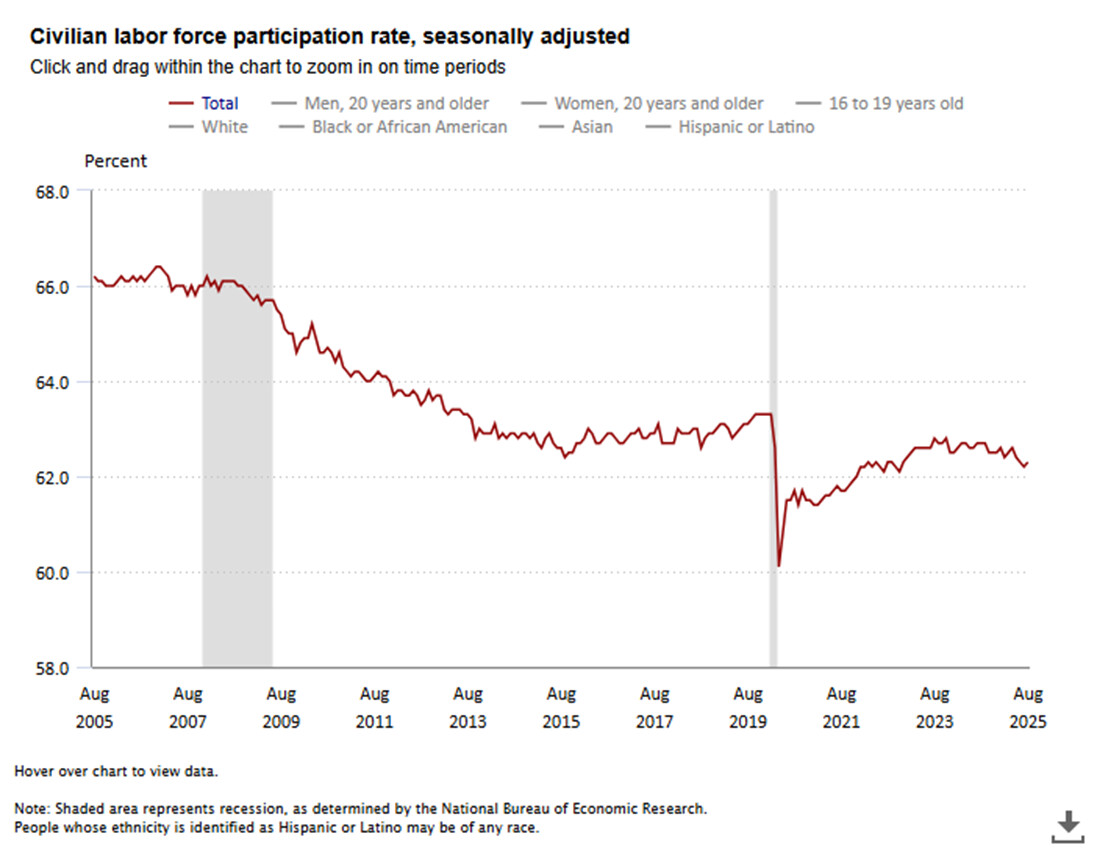
By contrast, the workforce participation rate, which is not counted in the unemployment rate (as it only counts those looking for work), is at a pre-pandemic low (going back to 2005).

We were on our way back to the lows set prior to the pandemic but have since turned downward/negative.

5 Likes

The mid to late 1960’s were a glorious period in the US economy. It was before stagflation.
College students, myself included, could work minimum wage jobs [$1.60/hour] while living at my parent’s home to generate adequate funds for the university tuition.

Ah, gasoline was 33.9 cents a gallon in them days.
Summertime and the living was easy.
Tougher for kids today.

5 Likes

The Lengths Americans Are Willing to Go to Make Every Penny Count

https://www.wsj.com/economy/consumers/the-lengths-americans-are-willing-to-go-to-make-every-penny-count-a79501fd

Simpson, a software marketer in Mississippi, added water to her Dawn dish liquid and her Clorox floor cleaner. She stopped buying aerosol glass cleaner and replaced it with a bottle of Windex so that she could add water to make the solution last longer. She even thought about diluting her treasured Sensodyne toothpaste, but drew the line there. She squeezes out every last bit instead.

Americans are increasingly experimenting with frugality. In addition to stretching household staples, some are shopping at less expensive grocers and buying pantry products on Facebook Marketplace. One consumer sought to save on beef by buying half a cow.

Consumer companies are getting hit by the frugality. As families like Simpson’s get more creative in pinching their pennies, the companies are seeing dimmer sales compared with the steady growth they have enjoyed in recent years.

Procter & Gamble reported volume declined 2% in the latest quarter in its home and fabric-care division, which includes brands like Tide detergent, Dawn dish liquid and Swiffer dusters. Meantime, private-label brands that make cheaper generics haven’t seen a corresponding increase, the company said last week, suggesting consumers are using up their inventory and making their existing stock last longer, rather than trading down.

Consumer companies are counting on consumers’ thriftiness to go away eventually.

They hope.

1 Like

The 60% quote is just one more example of the Pareto Distribution manifesting itself. When will these smart and high ranking people realize that nature loves the Pareto Distribution and whatever solution we come up with has to take it into consideration.

No, I don’t know the solution but at least I see (part of) the cause.

The Captain

Having living through them, I can confirm that the mid to late 1960s were more than half a century ago. :slightly_frowning_face:

DB2