Buy now, pay later is growing

“Buy now, pay later” is a growing model of consumer spending.

https://www.nytimes.com/2025/10/07/magazine/buy-now-pay-later-klarna-affirm-shopping.html

They Got to Live a Life of Luxury. Then Came the Fine Print.

‘Buy Now, Pay Later’ has built a delirious new culture of consumption — and trapped users in a vortex of debt.

By Amy X. Wang, The New York Times, Oct. 7, 2025

“Buy Now, Pay Later” model: Users make a fractional payment on a purchase while postponing the rest of the balance for several weeks, or sometimes even months or years. Under this delay-pay system, the lender typically scoops 2 to 9 percent of each transaction from the retailer, while the customer gets to enjoy her wares right away instead of having to wait until she’s paid them off in full, as was the case with layaway plans of decades past. When the time comes to cough up on an installment, the lender plucks the money automatically from the user’s linked financial account. Though B.N.P.L.s advertise “interest free” financing, the interest rate on longer-term plans can go as high as 36 percent; when payments fail to go through, late fees also pile up.

An estimated half of Americans have used B.N.P.L. at least once. Promising instant gratification to an economically eager audience — half of users are early-career individuals under the age of 33 — B.N.P.L. has scaled quickly as an industry, with the total value of purchases ballooning to around $120 billion in 2023 in the United States alone, up from just $2 billion in 2019. Affirm’s myriad competitors include Afterpay, Sezzle, Zip and the best known of the bunch, Klarna….

Getting approved for B.N.P.L. typically requires no minimum credit score: All you need is a cell number, proof that you are 18 or over and a payment method (bank account, debit card or credit card)..

B.N.P.L. services aren’t subject to any of [the legal limits on credit cards or the Truth in Lending Act]…[end quote]

Consumer spending is continuing to support GDP.

But to an LBYMer like me, these buy now, pay later programs are just a trap. It’s even worse than credit cards.

Wendy

4 Likes

And to a neo-Puritan like me its even worse than worse than credit cards, it is fundamentally immoral, on both the seller and buyer sides.

3 Likes

What’s the difference between using a credit card and BNPL?

DB2

Bnpl is,for the most part, allowed without any credit qualifications. It is generally used for smaller purchases under $1000.00 and the fees charged make up for the lack of credit underwriting.

Jk

I dunno. I’ve used Affirm, Klarna, and other services that offer zero interest payments. You can even set up automatic payments that make it a breeze! Bottom line, you have to understand what you’re signing up for.

5 Likes

Typically, with BNPL you pay in installments, like four or so, and then it is all paid off and you pay no interest. With a credit card you can make the minimum payments and pay interest for years before the debt is settled.

The problems start to arise when you don’t make the scheduled payments.

It is complicated for sure. Prohibitions against usury date back the Bible. Jews were forbidden to charge interest to other Jews and Christians were not supposed to charge interest to anyone–or at least that was the take for a few centuries. They’ve walked that one back a bit.

Polonius’s advice: Neither a lender nor borrower be.

But that’s too simple. Borrowing can be a good thing. Necessary sometimes. The problem is with people like the poor woman in the article who just can’t help herself and doesn’t understand money. She shot herself in the foot, but there need to be rules to protect people like that from themselves. Again, an old story. Problems with usury date back as far as we have recorded history, pretty much.

2 Likes

It’s no different than the government printing money. It’s no different than the government running a deficit. It’s no different than getting a mortgage to buy a house. It’s no different from buying shares on margin. It’s debt pure and simple. I believe the bible allows for debt forgiveness every so often.

Yes, the Old Testament Bible mandates regular debt forgiveness for Israelites, with the Sabbath Year in Deuteronomy 15 requiring debt cancellation every seven years and the Year of Jubilee in Leviticus 25 mandating it every 50 years. These practices aimed to alleviate poverty, restore equality, and prevent the perpetual bondage of debt, particularly among fellow Israelites.

Google AI

The Captain
avoids debt as much as possible

5 Likes

The Bible mandates it! The Jubilee also mandated the freeing of slaves and return of ancestral lands to original owners.

The only debts excluded from foregiveness in the Bible were student loans…

6 Likes

There may be no interest to the buyer in many cases.

But there IS interest to the person financing it. The seller (the store) sells the “note” at a discounted price, and that discount is the “interest” earned on that note. Obviously there will be plenty of defaults, so the discount amount is determined based on the desired return (to the investor) and the estimated level of defaults. One ironic thing is that very often, when a default occurs, the lender doesn’t even bother to repossess the item, or even work very hard at extracting payment, because the costs of doing so far outweigh the cost of simply taking the loss and moving on.

1 Like

I use PayPal, and have a PayPal Credit line of $8K. They charge no interest for six months but require a small monthly payment (not enough to pay off the balance). Kind of a hybrid system.

DB2

2 Likes

I used it a couple times about 25 years ago. Both bigger ticket items that they let me pay off over 12 months no interest. Of course the hope was I’d be late and boom, then comes the accumulated interest and late fees. Always paid it off on the 11th month.

I also pay off my credit card balance every month without fail. I put everything I can on the card for rewards points. Essentially pays for my woodworking hobby and DW’s gardening hobby.

2 Likes

For me it is not that interest payments are bad, it is that the temptation to consume needs restraint, and restraint teaches many many forms of wisdom.

7 Likes

Governments :supervillain: set a terrible example for We, the People!
The Captain

1 Like

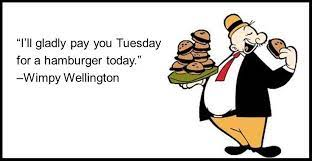
That’s fair. Reminds of a certain hamburger glutton.

4 Likes