Housing troubles

The housing market could be in for a rough time.

Aluminum mill shapes climbed 6.3% over the past year, steel mill products rose 5.1% and lumber and wood products increased 4.8%, according to the report. More extreme increases hit certain structural steel components, including a 22.5% spike in fabricated metal for bridges and 8.3% for bar joists and rebar.

“The fact that construction materials prices are rising even before the steepest proposed tariffs have taken effect doesn’t bode well for what will happen in August if the promised new tariffs are implemented,” said Ken Simonson, AGC chief economist. “Rising construction costs and economic uncertainty are already causing some owners to put projects on hold, which will only get worse if costs jump again.” Construction costs rise as tariff clock ticks | Construction Dive

Construction costs are rising before the worst of the tariffs. That can’t be good.

Good news is that construction wages have also gone up because of the labor shortage. Bad news is that there is still a massive labor shortage as the immigrant spigot (legal and illegal) is turned off. Immigration Raids Deepen Construction’s $10.8 Billion Labor Crisis

This is happening during a period of declining home prices with at least one measure showing 60% of counties experiencing declining home values. House Value Declines Spark Alarm: 'Something Big Could Be Happening' - Newsweek

This seems contradictory. It costs more to build a home, yet home prices are trending down. This strikes me as being a bad scenario as it suggests the market is worse than it looks. It suggests that supply is much higher than demand. This seems to be the case in TX.

So housing prices are in the decline because of declining demand probably resulting from rising inflation and economic uncertainty. Meanwhile, in a couple of weeks the next round of tariff hikes will hit, raising the cost of home construction higher. Also, immigration is declining which should further soften housing demand, particularly in the border states, which coincidentally are also showing the highest home price declines.

Lots of headwinds for home builders.

7 Likes

All of that is interesting. However, I think there’s a more fundamental problem. 1poorkid can’t afford her own place. And she’s in a job making at least 50% more than when I was fresh out of grad school, and it’s not even a job that requires college. Her friends can’t afford their own places either (at least not without roommates).

Home prices are out of reach for younger middle-class people.

I just checked our house. Zillow estimates it’s about $1M. We paid half that, including .8 acres and a custom build. How is anyone going to afford that if we decide to move? We had to stretch with two incomes (both engineering) to afford half that.

9 Likes

I am not in the market for a new-built home. I’ve seen shoddy construction before, and if the builders are replacing their immigrant tradesmen with inexperienced American born tradesmen ( and women ) then folks might want to put their new home purchase on the shelf for a couple of years or so. Pay higher prices for construction material, pay higher prices for construction workers, and get a shoddier constructed home. No thanks.

3 Likes

The price of anything is what a willing buyer pays a willing seller. The buyer will decide what they are willing to pay, and you will decide what you are willing to take, and when those two numbers meet, that will be the price. Zillow is just a guide based on “comps”, comparable houses that sold in the area, but the Zillow estimate moves up and down based on what willing buyers pay willing sellers in your area.

If suddenly people who own comparable houses in your area begin selling at once, then as time passes, a few of them might accept $950k instead of $1M, and then you will see the Zillow estimate start to go down.

1 Like

There is a housing affordability problem, but in many cases the problem is us. First off, there are lots of states and counties with affordable housing. These are places that people used to live during the good ol’ days of Andy Griffith and Petticoat Junction (showing my age). Not these days. Folks these days only are willing to live in places that happen to have housing shortages.

More importantly, people want bigger homes even as household size gets smaller. In other words, for most places not named San Francisco, starter home prices have risen above inflation primarily because people want much bigger homes. They also want homes with more amenities, like central air or cathedral ceilings, that weren’t typically asked for in the 1970s.

The Levittown homes built to accommodate the returning WWII vets averaged 750 sq ft. The average home size in 1963 was about 1300 sq ft and cost about $20K. Due to inflation, the purchasing power of a 1963 dollar has increased to about $10 today. One can find lots of 1300 sq ft homes for sale in Lincoln NE in the $200K-300K range, in other words at equivalent inflation-adjusted prices as in the 1960s. Of course one does have to pay 3-5X that in LA or SF or Austin. But is it really necessary to live in such high demand places?

There is actually a lot of affordable housing, but just not in the hot markets. We are a spoiled generation compared to the past. The WWII generation was more than happy to live in pre-fab huts in New Jersey. This generation is only willing to live on the coast or in a trendy university town or someplace with lots of golf courses and warm winters, and only in 2000+ sq ft MacMansions.

6 Likes

I would say a lot of it is where the jobs are. People want to live close to where they work because they don’t want to be stuck in traffic for 2 hours 5 days a week (round trip). WFH can address much of that, but most companies have walked-back their WFH policies since the pandemic “officially” ended.

Phoenix is a great example of that. There really isn’t much “affordable housing” here, for a variety of reasons including people from CA coming here and paying cash for houses (and, often, renting them out or doing the AirBnB thing).

I checked 1poorkid’s friend’s house. I’ve seen it. It does not have a garage (it’s a carport), is relatively small (eye-balling it, I’d say 1000sf), is in an old neighborhood in Mesa, and the area looks -for lack of a better term- “tired”. She lives with her boyfriend, and another roommate. Zillow estimates about $300K.

She has to have a roommate (in addition to the boyfriend) to afford it, and she has a decent job (all three do).

Sure, a lot of people are spoiled. But I suspect that the “hot markets” became hot largely because that is where you can find employment. The only reason I settled into Phoenix after grad school was this is where I found a job. I sent resumes all over the country, but I was hired here. So here I am, even though I don’t like the heat.

5 Likes

God gave us air conditioners so we could live in Texas.

Just saying
:expressionless_face:
ralph

2 Likes

“Major” middle class expenditures are often ruinous because people lack financial education and self-discipline, succumbing over and over again to attractive (status size and form, “sexiness” [if I owned that car/house/plasticized body I would get laid or otherwise become happy]).

Stupidly, far too many homes get built by developers successfully targetting and so increasing hollow desires and imprudent financial leaps by people who would be much happier if they had turned off “Lifestyles of the Rich and Famous” at the age of 6 and lived more like their pre 1970’s antecdents.

I grew up in my family’s “late Puritanical” culture and ethos, living in two successive small homes bought during market dips that we worked on and improved steadily (learning basic carpentry, electrical, plumbing, concrete work, ducting), adding to our comfort and the bottom line. We took advantage of the Los Angeles coastal zone, had no A/C, minimal heating, thick walls, heavily insulated roof and attic (I did most of the attic work) and the tight quarters resulted in a very closely connected family that HAD to get along.

I expect, giving the POVs here on METAR that most of you had some similar advantages that helped you avoid stupidity, like Wendy’s grandma. But I am curious about the stories. How come we are so weird?

2 Likes

People are weird these days because they’re fearful, for a number of good reasons. For one, increasing wealth concentration negatively affects asset affordability, and people’s economic prospects.

2 Likes

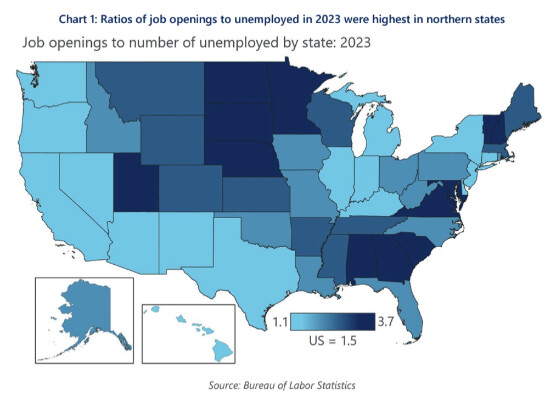
States with the highest ratio of job openings to unemployed are predominantly in states with relatively low housing costs (northern midwest and the south).

An interactive map showing much the same result is available here: Understanding America’s Labor Shortage: The Most Impacted States | U.S. Chamber of Commerce

It used to be that people would moved to where the jobs are, just as you did. They don’t anymore, even when the jobs are in places with lower cost of living. It seems that current Americans find a place they like and then complain about the lack of affordable housing. That is a choice freely made for most people. Folks would rather live paycheck to paycheck in Phoenix than afford a nice home and enjoy economic stability in Minnesota where there are a lot of job openings and cheaper housing.

This unwillingness to move has been discussed before. It is the strongest suggestion to me that America’s finest days may be over. The “pioneer spirit” seems dead. Our rejection of immigrants who by definition exhibit that behavior will only speed up the decline. Why we don’t want people who have the strength of character to walk across the Mexican desert just to find a menial job is beyond me. Instead we cater to a native born demographic who can only escape obesity through drugs, can only escape addiction by restricting needed pain killers, and who rather than move to where jobs are plentiful and housing cheap, blame immigrants for their woes.

6 Likes

I know Wendy is pretty strict. So if she deletes this post, so be it.

Since you -sorta- asked…

I was on the Prodigy boards back in the days of dial-up (if you’re under 40, google ‘dial-up’). Still in college. Initially it was mostly nerd-stuff (Star Trek, etc). At some point I stumbled or was directed (forget which) to a financial board (we later were featured in Kiplinger’s…they actually did a phone interview with me). I think I had a question of some sort. The more I hung out there, the more interested I became. I didn’t know Peter Lynch from Jim Cramer then. I got a book they recommended (“Making the Most of your Money”). Not long after, I found a low minimum mutual fund and put $500 in it. I was a grimly serious student with no life, living at home, so I had that much. I was all about mutual funds until after grad school when I was hired into a company that had stock. I transitioned to primarily individual stocks, though my retirement accounts were (and are) MFs.

I was raised relatively poor, by American standards. Mom divorced my cheating-louse of a father in 1969. I was one of the first latch key children, before that term even existed. Dad did pay his child support, but mom still struggled. Sometimes a bowl of rice was my dinner (I liked rice, so I didn’t really realize the situation until much later). I never had money, nor an allowance (she couldn’t spare it). So it never occurred to me to try to get a credit card when I was 18. If I wanted something, I would go to my S&L (yeah…if you’re under 30, google that, too), and withdraw what I needed, and go back to the store. It wasn’t until I realized that I could borrow the bank’s money interest free for 30 days, and then pay off the card , that I started using a credit card. I’m very mathematically inclined, and realized I was missing out by keeping my money in an S&L, especially after I hooked up with the Prodigy folks. The returns on MFs were a lot more than 2% (if I chose right). From then on, I shoveled what I could spare into MFs, and later individual stocks after grad school.

I think my only real advantage (other than not being born in a third world country) was that I was smart (don’t mean to boast, but every test I took in school placed me in the top few percent). I studied hard science and math, had part time jobs, and ended up with a good job after grad school. I really don’t enjoy going over annual reports, but it’s the price I pay for getting better returns than a savings account. Maybe another advantage was that I was not “cool” by most standards, had few friends, no girlfriend, so didn’t party at all. I studied. I took the same approach learning investing, and also learning to cook (a different story for another board).

7 Likes

It’s also the types of jobs. Sure, there are probably a lot of blue collar jobs in low cost of living areas. A good plumber is golden almost anywhere he/she wants to go. Is an electrical engineer going to get a job in North Dakota? Maybe, but probably not. Those sorts of jobs are in Silicon Valley, Silicon Desert (i.e. Arizona), Austin, and some others. Just as a “for example” (i.e. different specialties congregate in different areas). Unless you’re willing to commute 90 minutes into Phoenix, you’re not going to want to live in Globe if you have a technical job.

Ironically, the WFH actually enables people to live in less in-demand areas because they don’t have to show up in the office. But companies have been moving away from that for the past couple of years, demanding “RTO” (return to office).

But there is some truth to what you’re implying. There are places I would NOT want to live, even if they’re cheap. Most of the deep south, for example. I could probably deal with it by myself because I’m a white guy. 1poorlady is Filipina. I would not subject her to a locale that may not accept her, or our miscegenation. Also, as I get older, I need to be cognizant of being relatively close to good hospitals and good doctors. Both 1poorlady and I have histories that now need to be monitored regularly. Doc Peterson from Mayberry probably isn’t the best choice for us.

7 Likes

The President is suggesting back yard housing–600 to 1200 sf homes–often called mother-in-law cottages–to provide affordable housing. In the back of a 3 acre lot in my area they should fit right in. But will zoning laws allow it. Parking on the streets in the suburbs is already a problem. Two car garage is often filled with junk. So a typical five car family fills the driveway and street spaces. Then add that home in back. How many parking spaces? And where will they park.

A fun topic for discussion. But acquiring Greenland may be more likely.

3 Likes

Not surprisingly the president’s solution is really stoooopid for the reasons you point out. The reality is that there is no solution to the affordable housing problem in major cities as long a cars are the primary mode of transportation. It is simply not possible to create the needed population density because the auto infrastructure (roads and parking) require so much space.

Traffic gridlock limits population density. Low population density limits the number of residences per area. Limited housing means insufficient supply and higher prices.

High density, low cost housing and public transport have to be developed in tandem.

5 Likes

At the same time some cities are encouraging higher density housing. A friend of mind owns an old, large house in Santa Cruz, CA. The city subsidized the conversion of his garage into an apartment. (He now has people living there plus someone in an RV and several student types renting rooms.)

DB2

2 Likes

As long as they don’t own cars, that’s great. But if each household owns a vehicle there needs to be additional parking and traffic has increased. Combine such Accessory Dwelling Unit (ADU) programs with restrictions on car use and it might work. Otherwise the program ends as soon as local road capacity is exceeded.

1 Like

In Atlanta, the higher density housing has been build near MARTA rail stops. But interestingly enough, they almost all ended up being higher cost because people are willing to pay more to live near a MARTA rail stop. I don’t know the exact numbers, but as an example of what I am talking about -
2 BR apartment a short walk from MARTA - $3000/mo
2 BR apt half a mile away from MARTA - $2500/mo
2 BR apt more than a mile away from MARTA - $2000/mo

3 Likes

Looks like some are doing OK.

Here in my neck of the woods:

1/6 of an acre and 25-30 feet between houses
Current version of Levittown.

2 Likes

Las Cruces! We bought our first townhome there while my wife was in grad school. I wish we would have held on to it.

In my area this is known as R-4 zoning. Small lots abt 7000 sf gives you a nice house usually two story with 3 or 4 bedrooms, family room, two car garage. Up to abt 2500 sf. Many at 2000 sf. Many with walk out basement. This gives small postage stamp lawns (often on hillside for walkout). Small lot size lets them sell for close to local median.

Excellent homes for a growing family. Highly sought after. Affordable.

2 Likes