10 Years On: "Soured on Climate Politics"

It Isn’t Just the U.S. The Whole World Has Soured on Climate Politics.
https://www.nytimes.com/2025/09/16/magazine/climate-politics-us-world-paris-agreement.html
Ten years ago this fall, scientists and diplomats from 195 countries gathered in Le Bourget, just north of Paris, and hammered out a plan to save the world. They called it, blandly, the Paris Agreement…Paris wasn’t just a brief flare of climate optimism. To many, it looked like the promise of a whole new era…

A decade later, we are living in a very different world. At last year’s U.N. Climate Change Conference (COP29), the president of the host country, Azerbaijan’s Ilham Aliyev, praised oil and gas as “gifts from God,” and though the annual conferences since Paris were often high-profile, star-studded affairs, this time there were few world leaders to be found…

The retreat from climate politics has been widespread, even in the midst of a global green-energy boom. From 2019 to 2021, governments around the world added more than 300 climate-adaptation and mitigation policies each year, according to the energy analyst Nat Bullard. In 2023, the number dropped under 200. In 2024, it was only 50 or so. In many places — like in South America and in Europe — existing laws have already been weakened or are under pressure…

To our north, the former central banker Mark Carney…became prime minister of Canada in March and as his very first act in office struck down the country’s carbon tax…To our south, President Claudia Sheinbaum of Mexico, a former climate scientist, has invoked the principle of “energy sovereignty” and boasted of booming oil and gas production in her country…

“You can’t walk more than two feet at any global conference today without ‘pragmatism’ and ‘realism’ being thrown around as the order of the day,” says Jason Bordoff, a former Obama energy adviser who now runs Columbia University’s Center on Global Energy Policy. “But it’s not clear to me that anyone knows what those words mean other than this whole climate thing is just too hard.”…

Globally, concern about warming is still rising, but only slowly — and while large majorities in many countries say they support faster decarbonization, other polls show that voters don’t actually prioritize decarbonization and, crucially, aren’t willing to pay much to bring it about.

DB2
5 Likes

This is and was expected. Public is short term focused and longer term leadership is missing.

However, I have zero doubt that the world will move towards sustainable energy.

6 Likes

So you are saying that the merchants of doubt are winning.

8 Likes

Why does it have to mean anything other than “this whole climate thing is just too hard”?

Decarbonizing involves costs. Those costs will be large. It is very hard to get people to agree to bear large costs, especially when there is no agreed-upon way to allocate those costs among people and no mechanism to do it.

It’s too hard to do, so it hasn’t been getting done. And it sounds like policy makers are beginning to accept that it’s not going to get any less hard, nor any more likely to get done.

And that’s why we don’t have material efforts to decarbonize….

I don’t think so. People support decarbonizing, and generally believe climate change is real. They just aren’t willing to personally pay the costs to stop that from happening. They’ve never really been willing to personally pay those costs.

9 Likes

Probably, but it will be a long, slow slog. While the use of renewables is growing, so are non-renewables. Fossil fuels accounted for just over 80% of global energy consumed, which is where it was in 2019 and 2009 and 1990. Running to stay in place.

DB2

2 Likes

Yes, the oil economies are subsidized and propped by vested interests including $Trillion wars as well as massive amounts of money spent on health due to carbon pollution in the air.

When the switch occurs it will be fast. I suspect we are 5 years away.
Solar + nuclear are ramping fast.

Internet was slow for a long time and then there was sudden disruption of of phonebooks, travel agencies, newspapers, movie rentals, shopping etc.

2 Likes

Not likely because of the tremendous costs involved. Also because of the long lead times for projects and the multi-decade lifespans of current infrastructure.

DB2

2 Likes

Cannot be done. It’s a hit piece of sorts. What were all the other real scientists doing while all the obscuring was going on? So, the massive pervasive indestructible truth succumbs to “a handful” of scientists? Maybe that says something about science and scientists?

In all fairness the reality is the warmists have not presented a very compelling case. Their position and data are full of more hedges,equivocations, if’s/ands/and buts than a customer service contract. And none of the disasters they professed have come true. It’s more marketing than science. People are noticing that the world isn’t ending. And that’s the science so far. Believe what you must. That’s what people do with religion.

1 Like

I think they have presented a very compelling case. But I also believe we will not act if it costs us convenience or money. Consequently, the warming crisis will eventually kill us all and turn the planet in to a lifeless rock! I’ve always wondered at what temperature do biological processes become impossible?

JimA

7 Likes

People in Shanghai were not able to breathe.

China launched a “War Against Pollution” with its 2013 Air Pollution Action Plan and subsequent, aggressive multi-year plans. This led to a significant, sustained improvement in air quality in major cities like Shanghai.

The Major Policy Changes in China:

  • Industrial Restructuring: Old, heavily polluting factories and industrial capacity (especially in sectors like iron and steel) were shut down, upgraded with stricter emission controls, or moved away from major urban centers like Shanghai.
  • Coal Reduction: China drastically reduced its reliance on coal for heating and power, particularly in and around major cities, by switching to natural gas and promoting clean energy alternatives. New coal-fired power plants were banned in some key areas.
  • Vehicle Emission Controls: Authorities implemented strict limits on the number of new cars, promoted electric vehicles, retired older, high-polluting vehicles, and tightened emission standards for diesel trucks.
  • Strict Enforcement & Budget: The government committed massive resources (hundreds of billions of dollars) and created a comprehensive regulatory framework with rigorous monitoring, strict enforcement, and clear penalties for non-compliance.

The Result: Air pollution in China, including Shanghai, has significantly declined. Shanghai, in particular, has seen a vast reduction in the extremely high pollution spikes that were common a decade ago. While its air quality is still not up to the World Health Organization’s (WHO) most stringent standards, the improvement has been dramatic and has added years to the average life expectancy of its citizens.

How much money are you willing to pay to breathe ?

5 Likes

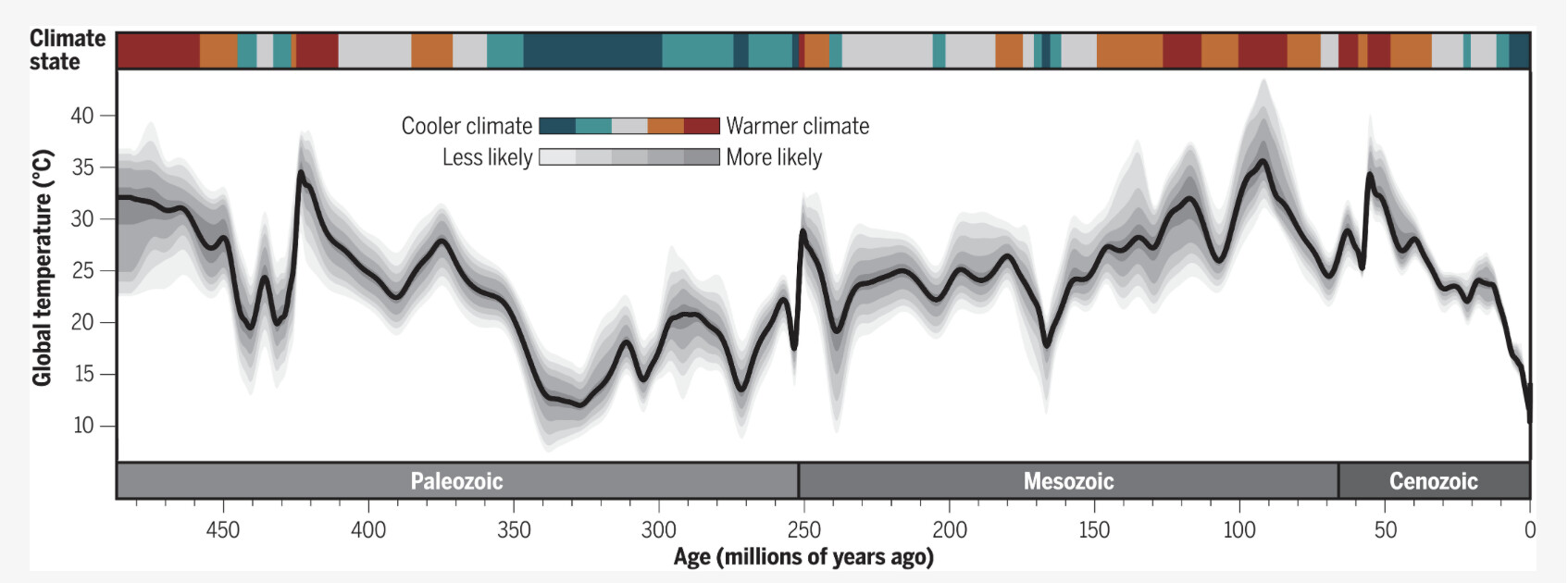
I hope you don’t really believe that. Here is a graph of the average global temperature since life arose. As you can see, we are at the very cold end of things.

https://www.science.org/doi/10.1126/science.adk3705

DB2

2 Likes

It is better not to test this. I don’t want to be part of this stupid experiment.

1 Like

Me neither. Divi brings up the successes of China after FCorelli says there has not been a very compelling case. We should add Los Angeles, which was horribly polluted until CA decided auto emissions needed to be stricter there. Waterways used to be horribly polluted by industry. I remember the days when acid rain was hurting automotive paint prematurely. The list goes on.

If anyone thinks the cost or renewables is too high (it isn’t), just look at the cost of doing nothing. It’s the same argument I use against the expense of terraforming Mars: if we can afford to turn Mars into an Earth, we can afford to turn Earth back into an Earth for far less.

11 Likes

It is a fiercely contested question whether the cost of doing nothing is higher than the cost of decarbonizing. To say nothing of the question of who bears the cost of doing nothing vs. who bears the cost of decarbonizing - which even more than the first question is the reason why we’re not going to decarbonize.

4 Likes

The problem behind Jim’s comment is that in order to motivate people, apocalyptic climate predictions are used. We have the Secretary-General of the UN talking about boiling oceans.

The apocalyptic climate narrative is seriously misleading and a socially destructive guide for public policy. The narrative radically overstates the risks to humanity of continued global warming, which are manageable, not existential. It also is harmful to mental health (PTSD – Pre-Traumatic Stress Disorder?)

DB2

2 Likes

I don’t believe the narrative overstates the risks. I believe this is an existential crisis. Of course, I’m old and don’t have to worry about my non-existent great-great grandchildren.

JimA

4 Likes

Experts at Britain’s top climate research centre have launched a blistering attack on scientific colleagues and journalists who exaggerate the effects of global warming.

The Met Office Hadley Centre, one of the most prestigious research facilities in the world, says recent “apocalyptic predictions” about Arctic ice melt and soaring temperatures are as bad as claims that global warming does not exist. Such statements, however well-intentioned, distort the science and could undermine efforts to tackle carbon emissions, it says.

DB2

4 Likes

The problem is that there’s so many other people who don’t want to be part of the alternative, where they end up paying more for energy and other things that contribute to carbon emissions. If you’re a person where those increased costs are really going to diminish your quality of life, rather than just be a trivial expense, you might decide that it’s better to test it than take the assured hit of having to pay to avoid it.

3 Likes

I do not agree with this ‘both siderisms’ take. Saying there is no problem/issue is far worse than proclamations of disaster ahead. But keeping their mouths shut would be worse yet. What do we want scientists (climate scientists) to say on the matter. “Don’t worry; nothing to see here.” Most, if not all, of the doom forecasting is social media; this is where the tone is being set. But what should anyone be saying to foster some sense of urgency in achieving a goal that impacts people 200 years from now? I don’t believe we can achieve even the most minimal goal. Actually, I’m starting to come the solution to the Fermi Paradox. Perhaps all tech civilizations eventually overheat their planet as energy is the critical piece of all tech civilizations.

JimA

3 Likes