Economics Nobel for Tech-driven Growth

Three Share Nobel in Economics for Work on How Technology Drives Growth

Joel Mokyr, Philippe Aghion and Peter Howitt won the prize for showing how “society must keep an eye on the factors that generate and sustain economic growth,” an award committee member said.

By Eshe Nelson, The New York Times, Oct. 13, 2025

The Nobel Memorial Prize in Economic Sciences was awarded on Monday to Joel Mokyr of Northwestern University, Philippe Aghion of INSEAD and the London School of Economics and Peter Howitt of Brown University for their work on how innovation drives economic growth.

The three economists shared the prize for research that explains the relationship between technological progress and sustained economic growth that has improved living standards, health and quality of life for people around the world. The prize committee said that their work would help ensure that growth was maintained and could be steered in the direction to support humankind.

For most of human history, there was very little economic growth, John Hassler, the chair of the prize committee, said in a ceremony announcing the award. Despite important discoveries that improved living conditions, growth leveled off. But over the past two centuries, that changed. “Sustained economic growth, driven by a continuous stream of technological innovations and improvements, has replaced stagnation,” Mr. Hassler said….

Mr. Mokyr’s work, such as his book “A Culture of Growth: Origins of the Modern Economy,” has also emphasized the importance of society being open to new ideas and allowing change….

Mr. Aghion and Mr. Howitt shared the other half of the award for what the committee described as “the theory of sustained growth through creative destruction.” They built a mathematical model for growth, with creative destruction as a core element.

The committee described creative destruction as “an endless process in which new and better products replace the old.”… [end quote]

I would like to read the book. It sounds interesting.

Cultural factors which protect inventors, foster the spread of knowledge and allow innovators to personally profit are essential for tech-driven growth.

Wendy
6 Likes

That won’t age well in the US. We need to rely on tax policy.

It will play nicely in the EU.

Amazing!

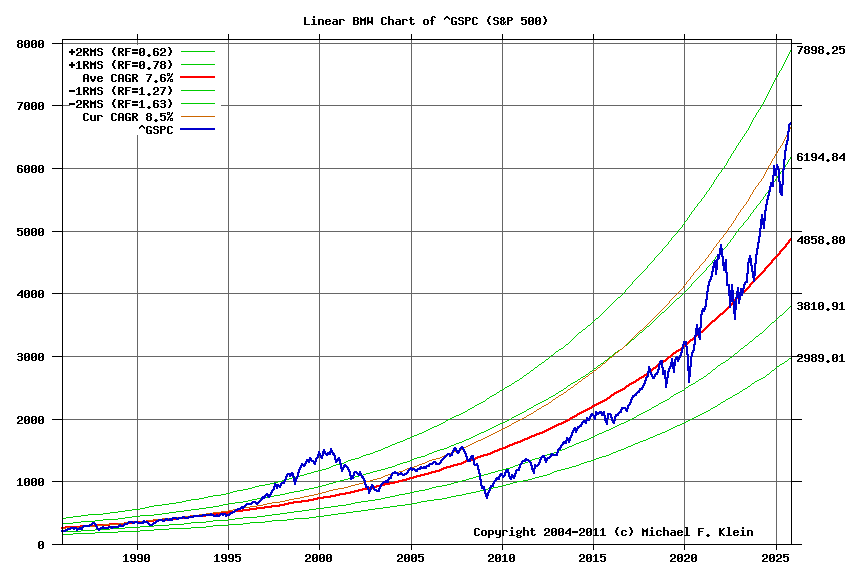
A few days ago I published the S&P 500 40 year stock chart that shows remarkably steady grow. Here is another version:

It did nothing for the first 15 years, but the last 15 have been gangbusters.

Maybe John Hassler is looking at the wrong charts.

Wanna scare people? Show linear charts for exponential growth. You will always see that scary curve.

If something grows at 1%, from 100 it grows to 101 in one year

If something grows at 1%, from 1000 it grows to 1010 in one year

but the growth rate has not changed! But 10 is ten times bigger than 1!

John Hassler needs remedial chart gazing. :winking_face_with_tongue:

The Captain

2 Likes

The growth of the S&P500 over the last 15 years is due to the Federal Reserve pumping a huge amount of fiat dollars into the financial system while dropping the fed funds rate (suppressing real interest rates to below zero so investors had little incentive to invest in bonds).

Economic growth is shown by Real GDP, not by the increase of the S&P500 index. As you can see, the percent growth of Real GDP is far less than the growth of the S&P500 index.

Wendy

6 Likes

Don’t you see the difference between the linear and the semi log charts?

The Captain

2 Likes

The big drivers have been (and I will likely leave a couple out as I type this over a sandwich)

Taming Fire: allowed people to eat more concentrated protein (meat)

Agriculture: allowed more regular diet

Metal: gave people better tools and more permanence of implements

Then nothing much until the Industrial Revolution, which produced factory work, paychecks, housing

Railroads made transit for goods and people vastly larger

Electricity, which gave us light at night, and later washing machines and refrigerators and stuff

Telephone: a subset of electricity, maybe, which gave instant and wide communication ability

Automobiles, which changed the way we live

Some 20th century stuff like airplanes and radio and things, and consumerism in general, but nothing truly earth shattering until

Computers (transistors, microchips, etc.) and a few decades later the personal computer

Followed by the Internet

Followed by AI

I’m not sure what things I missed, but the gap between “metal” and “Industrial Revolution” is so vast, and that between Computers/Internet/AI so small - yet each on of these (save the first two) have produced a gold-rush mentality which has, in time, changed peoples’ lives, society in general, and the economy of the world.

At least several of them have also led to gigantic bubbles: railroads and internet, for instance. I have little doubt that we are in a repeat with AI, that much good will come from it, that some bad will come of it, and that some people will lose a lot before it’s all over.

The big “swell” after the personal computer craze barely died out before it was replaced by the internet stampede, which is fairly ho-hum these days, just as it is to be replaced by the boom in AI (whatever that turns out to be.)

We live in interesting times. They come faster and faster now. I can’t imagine what it will be like in another 50 years.

6 Likes

I see this linear chart showing GDP since Roman times circulating the internet. Easy to laugh and point fingers.

The chart mentions Maddison. Google found Maddison’s data in an excel file so I downloaded it and drew the chart below. GDP takes off after the industrial revolution, even on semi-log axes.

I suspect Hassler understands log charts.

3 Likes

You’re seriously trying to suggest an Econ professor from Stockholm how is on the Nobel committee doesn’t understand log charts…

2 Likes

The social factors that make progress possible are explained in the wonderful book, “The Birth of Plenty : How the Prosperity of the Modern World was Created,” by William J. Bernstein. Every METAR should read this book.

Eschewing the myopia of recency…

The Roman Empire made plenty of technical/ engineering progress and lasted hundreds of years. But it eventually fell when the social factors which made it strong eroded at the same time that its resources were overtaxed by military overreach. The same has happened to more recent Great Powers.

It would be well to remember that material/ technological progress springs from entrepreneurial development in a stable legal environment where inventors, investors and marketers can offer their products and services profitably, protected by the rule of law.

Anything that erodes this system or burdens it unduly with non-productive withdrawals undermines and could potentially topple the edifice.

Wendy

4 Likes

It’s one of two possibilities, the other is that it’s being used to scare the unwashed masses into submission on subjects like Climate Catastrophe.

Not too long ago Neil deGrasse Tyson mentioned the subject in one of his podcasts, the inevitable curve that shows up in linear charts graphing exponential growth. Why would he bring up the subject if it was trivial? Because most people don’t realize this effect. Being an Econ professor from Stockholm does not guarantee he knows it or that knowing it he does not use it as a weapon to brainwash the unwashed masses.

The next time you see one of these scary graphs take the time to see if it is a linear chart plotting an exponential growth phenomenon. If so, you can safely disregard the presenter as either clueless or wilfully deceptive.

The Captain

2 Likes

The Great War (WWI) ended many empires including Austro-Hungarian, German, Ottoman, and Russian. The British empire followed soon after.

The Captain

There are at least 3 possibilities if you include the most obvious and likely one: the prof knows exponential and log charts and is presenting info with good faith and intentions.

No unlikely or nefarious scenario needed.

3 Likes

I like to protect myself from good faith and intentions.

The Captain

2 Likes

You know very well that the simplest explanation is the most likely in this case.

Who before has written KISS?

1 Like

Why can’t we do both?

intercst

Technologies are opportunities and productivity. Yes make money.

During the supply side period, the money fell to the bottom line, but did you notice that any discussion of improving the standard of living was dropped?

Optimizing the US economy it is not. We have mounting federal debt. We need to optimize the US economy for growth. It is a different thing.