Peak oil demand in 2030?

I’m old enough to remember when “peak oil” meant “peak oil production” and the price of oil rose to $147 per barrel.

Now “peak oil” means “peak oil demand” because the growth of alternative energy sources has been expected to reduce the demand for fossil fuels.

But will that happen?

https://www.nytimes.com/2025/11/12/climate/iea-fossil-fuel-forecast.html

There’s a New Forecast for Peak Oil Demand. It’s Increasingly Cloudy.

The International Energy Agency once projected that oil and gas demand could level off by 2030. Now it’s backing off, sort of.

By Brad Plumer, The New York Times, Nov. 12, 2025

The world’s leading energy agency is backing away, sort of, from its view that global demand for fossil fuels could very well peak by the end of the decade.

Two years ago, the International Energy Agency caused a stir when it published a widely read analysis suggesting that the world’s use of oil, gas and coal could start to decline by the 2030s because of the energy policies many governments were pursuing. The prospect that fossil fuel demand might soon peak was seen as a potential turning point in efforts to slow climate change.

But in a major new report published on Wednesday, the energy agency has a different message about a peak in fossil fuel use: It’s complicated….

Unlike last year, the agency is also including a more conservative “current policies” scenario that assumes countries won’t enact any additional energy policies and will face obstacles in shifting to cleaner forms of power….

The I.E.A. report also notes that nations are still lagging on another front: Ensuring that everyone has access to basic energy services. Roughly 730 million people still lack access to electricity, and an additional 2 billion rely on polluting and unhealthy cooking methods like burning wood or dung indoors….[end quote]

Here’s the link to the report.

Here’s the chart for the The Energy Select Sector SPDR Fund (XLE) and the SPDR S&P Oil & Gas Exploration & Production ETF which I think is probably a reasonable proxies for the different aspects of the fossil fuel sector.

They look pretty stable for a sector that was predicted to peak and then vanish in 5 years.

Wendy
3 Likes

I have said it before and I’ve seen nothing to change my mind: we will pump Mother Earth dry until we have consumed every bit of burn able/combustible carbon on the planet.

No matter how much we have, we find endless new uses for electricity, and even if we find better sources for vehicle propulsion there’s always going to be some, whether it’s trucks or trains or jets or whatever.

Investor sentiment may wax and wane depending on which articles are written and published in the “prestigious” press, but the reality is we’re going to burn every drop.

6 Likes

There is an old saying that roughly goes: “The stone age didn’t end because they ran out of stones.”

That being said, since petroleum products are mostly used in the transportation sector, and the primary “alternative” to the internal combustion engine is the lithium-ion battery, with all of its associated drawbacks, I believe we will be burning petroleum products in transportation vehicles well into the future.

_ Pete

Peak oil means that oil consumption will slowly start declining in 2025 or 2027 or 2029 or 2030. Peak oil consumption does not mean oil consumption stops.

1 Like

Yes -* It will happen because Peak Oil Consumption is slowing down. The economic forces are against oil consumption increasing much longer. China, Europe and most of the rest of the world are working to mitigate GHG emissions by adopting rules and regulations to stop using oil for transportation and heating,* to generate electricity, and as a feedstock for producing petrochemicals used in a vast array of products like plastics, fertilizers, paints, and medicines. It is also used to create lubricants, asphalt for roads, and numerous other materials that are essential to modern life.

Why are these rules and regulations being adopted? Because of climate change and the expensive horrors of increasing global temperatures, storms, floods, and other disasters on land and oceans that are caused by fossil fuels.

Alternative clean energies are already replacing oil in transportation, heating and electricity. IMO, Peak Oil consumption will occur in 2026.

I didn’t say it did. And while growth of consumption may decline, I’ll take the bet that gross consumption will continue to grow into the 1930’s, albeit at a somewhat slower pace.

Right now the growth is 730,000 barrels per day each year. Total consumption worldwide is over 100,000,000 bbl per day. EV adoption is decreasing that by a mere 5m bbl, while industry, other transportation, power generation and heating and other continue to grow.

Eventually those lines will cross, but it’s a lot further out than these projections, simply because we continue to find new uses for it. It’s not as though everything remains static while EVs eat away at it. Nuclear is too far away, solar and wind too small (but growing), hydro already close to maxed, and that leaves: petrochemical.

Caveat: the worldwide economy has a lot to say about this. A recession/depression would throw all these projections out the window before you could blink. A roaring economy likewise.

In the future sometime. But not within 5 years IMO.
The current US administration is pursuing a Drill, Drill, Drill Policy.
New ocean drill technology mean more product in Gulf of Mexico:
https://www.reuters.com/business/energy/improved-drilling-boost-gulf-mexico-offshore-oil-output-us-onshore-growth-slows-2025-10-15/
TECHNOLOGY UNLOCKS 'SIGNIFICANT DEEPWATER RESERVES

And:

The rise of EVs within the US is occurring, but slowly. The increased depreciation of EVs is the sweet spot of buying an EV in the mid-$25k range.

https://insideevs.com/news/778623/used-evs-are-selling-faster-than-used-gas-cars/
Take a look at the average prices of three-year-old used EVs in the table below. Apart from the Model S, which averages $44,621, the rest of the seven EVs are all priced in the mid-$20,000s, which is emblematic of how affordability drives adoption. In most cases, buyers are getting a far more high-tech vehicle compared to gas cars of the same price, and with much lower operating costs.

In the mid-$20,000 price range, however, the value proposition for EVs is strong.

Will the mid-$20000 price be maintained as these fly out the door>sold? Doesn’t supply & demand apply to used EVs?
Perhaps the substitution of EVs for ICE vehicles will occur by replacement with used EVs.

Meanwhile:

1 Like

And relevant to this topic, we didn’t stop using stone as a building material just because the stone age ended.

There seems to be a growing acceptance of - or resignation to - the idea that we’re not going to have an energy transition. That all of the new renewable energy sources and the technologies that allow them are going to be mostly additive to our fossil fuel consumption and not replace it. The theory goes that we didn’t stop using wood when we started heavily mining coal, we didn’t stop mining coal when we started heavily pumping oil…and we’re not likely to stop using wood and coal and oil just because we now have solar and high-tech wind.

6 Likes

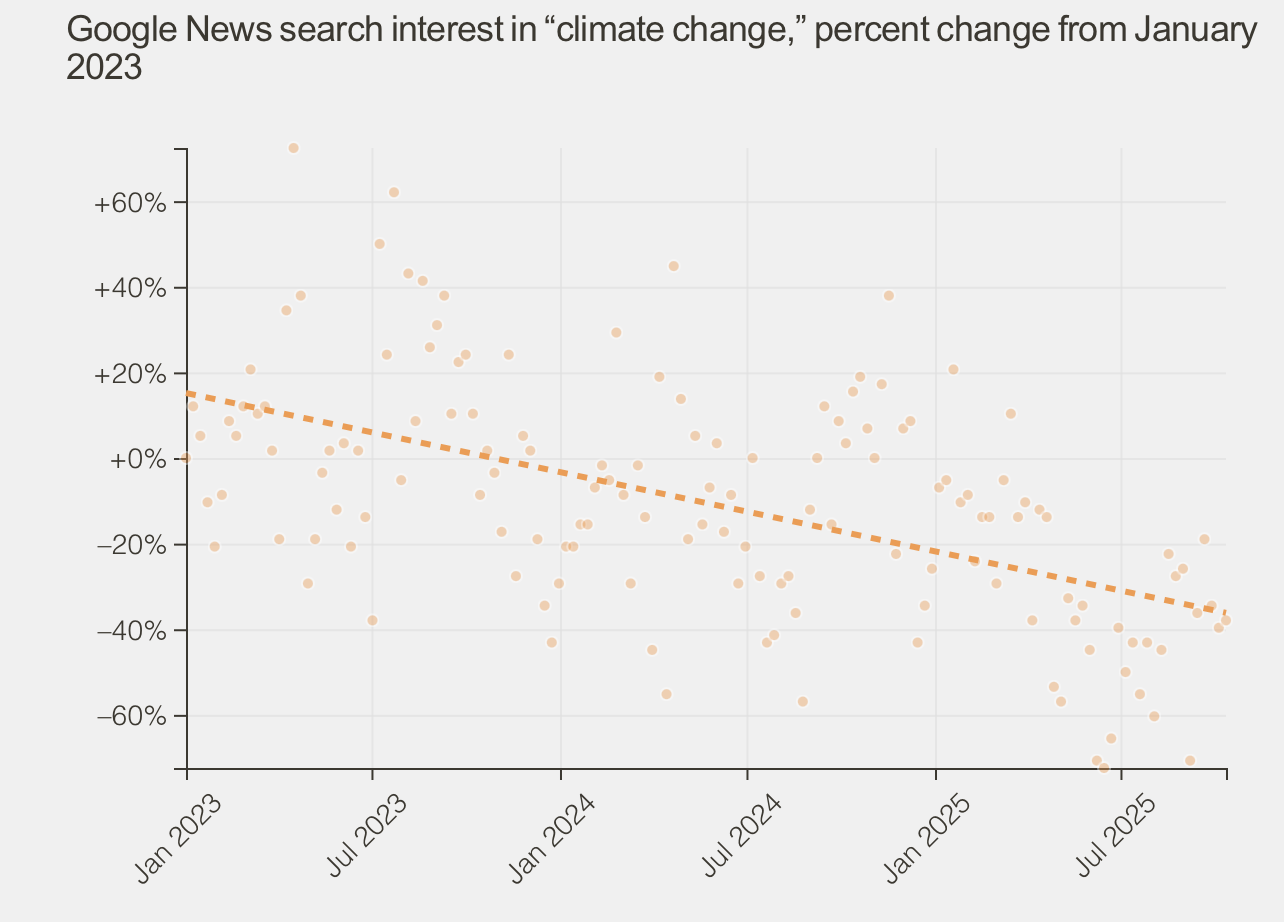
There is declining interest in climate change when looking at the number of Google searches.

DB2

1 Like

Good to hear! HiTime!

The Captain

2 Likes

Albaby’s response is better than mine

The theory goes that we didn’t stop using wood when we started heavily mining coal, we didn’t stop mining coal when we started heavily pumping oil…and we’re not likely to stop using wood and coal and oil just because we now have solar and high-tech wind.

But I’ve always thought the original quote, while cute, was silly. Stones weren’t “consumed”. They didn’t produce energy. They are in infinite supply - all things that are the antithesis of oil (wood, coal.)

1 Like

Peak oil demand might be today. Depends on how soon we go into a great depression. Any day going forward where the market dumps like today is suspect.

Industry uses oil for some heating along with natural gas, coal, wood, solar, and electricity.

Some homes and buildings use oil for heating, but most use natural gas, coal, wood, solar, and electricity.

Electrical generation uses very little oil, while natural gas, coal, renewables and nuclear generate the most electricity. Renewables generate more electricity than nuclear. Hydrogen is being pursued as a co-fired fuel with natural gas, coal, wood, and biomass.

Ships, heavy trucks, construction and farm equipment use diesel with some converting to electricity/batteries.

Aircraft use refined oil, but electricity/batteries are being pursued.

1 Like

Peak oil consumption is a global concept, not just US.

That is because people understand climate change causes and effects after years of hearing about it in schools, colleges, TV news and science programs, internet news and science programs, and seeing of how the earth is heating up, wildfires across many countries, record tropical storms, record rainfalls/floods, sea level rise, glaciers melting, and polar ice disappearing. Therefore, they do not need to do so many Google searches.

3 Likes

Forecast for Global electricity generation:

Global solar doubles by 2030, overtaking gas in 2033 and coal in 2034

Global wind doubles by 2030, overtaking gas in 2033 and coal in 2034

This year’s Energy Transition Outlook by Wood Mackenzie is not as ‘sunny’ as last year’s. (There is a lot in the executive summary that sounds familiar if you’ve read my posts.)

The global push to tackle climate change has slowed. Ten years on from the Paris Agreement no major G7 country appears on track to meet their 2030 emissions reduction targets. Announced goals for emissions reduction by 2035 lack ambition, suggesting too many governments are ‘kicking the can down the road’…

Governments in many developed countries are prioritizing securing affordable energy above achieving their energy sustainability goals

While renewables’ share of global power supply increased from 5% to 20% over the past decade, it barely met incremental demand growth. Scaling up low carbon supply faster than demand growth and building a new deeply decarbonized, resilient energy system is proving tougher than envisaged.

At Wood Mackenzie we envisage an ‘energy evolution’ in which fossil fuels remain the bedrock of supply for decades to come.

DB2

2 Likes

I don’t think the IEA outlook has changed. The new language causing all the consternation was added only because of a US threat to pull out of the IEA.

Under intense pressure from the Trump administration, the International Energy Agency (IEA) has issued a carefully-hedged analysis that still shows fossil fuel demand peaking within years, but also portrays an alternate universe of sustained consumption where average global warming approaches 3°C. IEA Puts ‘Poison on the Menu’ But Maintains Net-Zero Scenario Despite Pressure from Trump

It wasn’t because of any new developments or analysis.

But in a briefing following the report release Wednesday morning, the IEA said the net-zero scenario still indicates no new investment in longer-term oil and gas megaprojects.

The more hopeful analogies involve wind driven sailing vessels, horse-drawn carriages, whale oil, and the telegraph. They haven’t disappeared but they also aren’t significant.

1 Like

Hopeful…but I daresay not realistic, given early indications.

We’re a few decades into having alternatives to wood and coal and oil. I mean, wind has existed for centuries and solar’s been around since the 1970’s….but the modern wind and solar era is at least as old as the early 2000’s. That’s when China started supercharging their solar panel manufacturing and we started to see real high-tech wind generation begin to sprout up. They are still growing - yet there is little indication so far that those “new” energy sources are replacing, rather than adding to, fossil fuel energy sources. In much the same way that coal did not replace wood, and oil did not replace coal, the early returns suggest that these energy sources are additive rather than substitutive.

We’ll see. Power plants and refineries are big capital investments that have a much longer useful life than a horse or an ox, and the steamship/telephone transitions took around four decades to really happen. But then again, solar and wind have dispersed and been adopted globally at a much faster pace than the brand-new technologies of steamships and telephones, without beginning the decline of coal or oil usage.

3 Likes