It’s amazing how few people are commenting here at this point – I hate to think the community is dead or near dead. Compare to times when the the price was around $3.
Meanwhile, there’s this.
I can’t believe, when I look back over the last 26+ years since I joined this forum, what AMD has become. (For that matter, I can’t believe what NVDA has become, or what the whole industry has become.)
@Roleplayer who else is still even here from the early days? And who’s still on board?
https://seekingalpha.com/article/4884823-amds-real-shift-is-still-mispriced
What is interesting to me about AMD (AMD) is no longer the fact that they have become a legitimate competitor to AI technology which is obvious at this point but the way the company is perceived. The question is no longer how well Instinct GPUs sell, but whether AMD can deliver complete systems, secure its supply chain and translate that into sustained earnings growth.
We know the financials have already reflected the fact that the company is no longer simply a secondary player to AI technology. We know the stock is not euphoric and that the stock is sitting right in the middle of the expectations curve, where expectations are high but not so high as to expect perfection. To me, the next phase is no longer about how the chip performs relative to others but how the system performs relative to others.
The Market Missed the Real Shift
The most important event occurred on March 18 as AMD and Samsung (SSNLF) entered into an MOU which makes Samsung an aligned primary HBM4 supplier for the MI455X and a DDR5 partner for 6th Gen EPYC Venice, as well as a discussion for foundry services.
While I do not think that memoranda should be considered comparable to revenue, this is an important event because it addresses a constraint that investors think of as a footnote. The constraint for infrastructure spend in the AI space is not just the acceleration device, it is the memory, the packaging, the thermal design, the interconnect and the timing.
Samsung HBM4 is already described as being mass production ready, with speeds up to 13 Gbps and 3.3 TB/s bandwidth which tells me that AMD is attempting to de-risk supply and system readiness before the launch of their Helios. That is the behavior of a company that is preparing for platform wars, not just a company attempting to win a few benchmark wars.
My mind always comes back to the simple fact. MI300 and MI350 made AMD relevant. Helios and Venice will determine if AMD becomes a harder competitor to beat and the reason is quite simple as the discussion is moving from standalone accelerators to full rack economics. They’ve already said 2026 is going to be an inflection point where MI450 revenue begins in the third quarter and ramps up more substantially in the fourth quarter but also noting the fact that the vast majority of 2026 MI450 revenue comes from RackScale solutions.
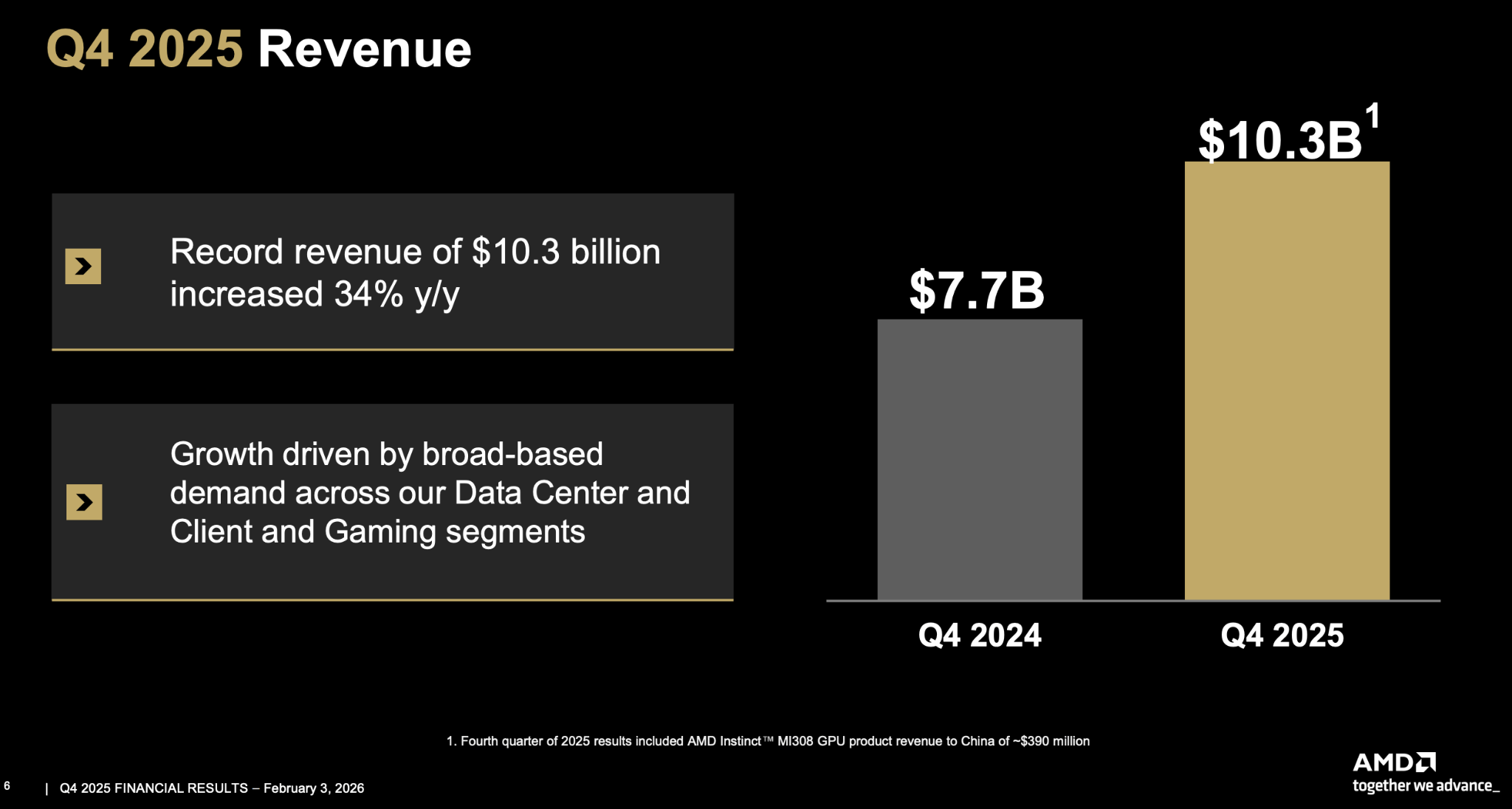
Q4 Revenue
Venice is the quiet part of this story and I think it’s still a somewhat underrated part. Lisa Su talked about how the customer pull for Venice is extremely high and there’s already large-scale engagement happening in the cloud. I think this is important because it’s a nod to how well the server CPU business for AMD is not only surviving but becoming a leverage play within the development of the AI solution itself.
Everyone gets so caught up in the GPU discussion that they forget how important the CPU is in terms of orchestration, preprocessing, storage-centric workloads, and agent-based workloads that spawn off into more traditional compute. If EPYC continues to grow share and Instinct continues to grow, AMD’s data center business is much more balanced and a heck of a lot more sustainable than the notion of a one-trick pony.
I also don’t place too much weight on comparisons to Nvidia (NVDA) which some investors seem overly concerned about. Nvidia is still the de facto standard in many places, especially in software stacks and fully integrated rack scale execution. I don’t have an issue with that. I want to see how well AMD can become good enough, broad enough and available enough to become a sustainable second source at hyperscaler scale. Eight out of ten of the top ten players in the market have Instinct in production and EPYC cloud instances grew over 50% in 2025 to almost 1,600.
Valuation Is a Bet on Timing Not Just Growth
AMD is also cheaper on a revenue multiple basis compared to Nvidia and Broadcom (AVGO) but not so cheap that execution risk is ignored, and that’s why I am bullish on the company. Essentially, the market is still discounting AMD’s ability to fully leverage the AI opportunity at the system level, and to me, that’s the opportunity.
What’s interesting is that when you look at the company’s earnings AMD’s forward multiple is actually trading at 30x Price/Earnings and 28.6x EV/EBITDA, which is actually ahead of Nvidia and Broadcom on an EV/EBITDA basis. That tells me that the market believes in the growth but they haven’t priced the margins. Essentially, they’re pricing AMD on what they could be not what they have become.
However, AMD appears to be at a much more reasonable valuation when looking at the forward Price/Sales basis, which is part of the reason why I’m so bullish on the stock. If Helios and Venice work, the market will immediately close this gap and properly rate AMD as a system player. If they don’t, we’ll see the downside risk. I am willing to take this asymmetry because I think the market is still discounting the upside potential if AMD can get this right.