Forget TACO. Trump Is Winning His Trade War.
The president wants tariffs, the higher the better. Whether that is achieved unilaterally or via deals is secondary.
By Greg Ip, The Wall Street Journal, July 15, 2025
…
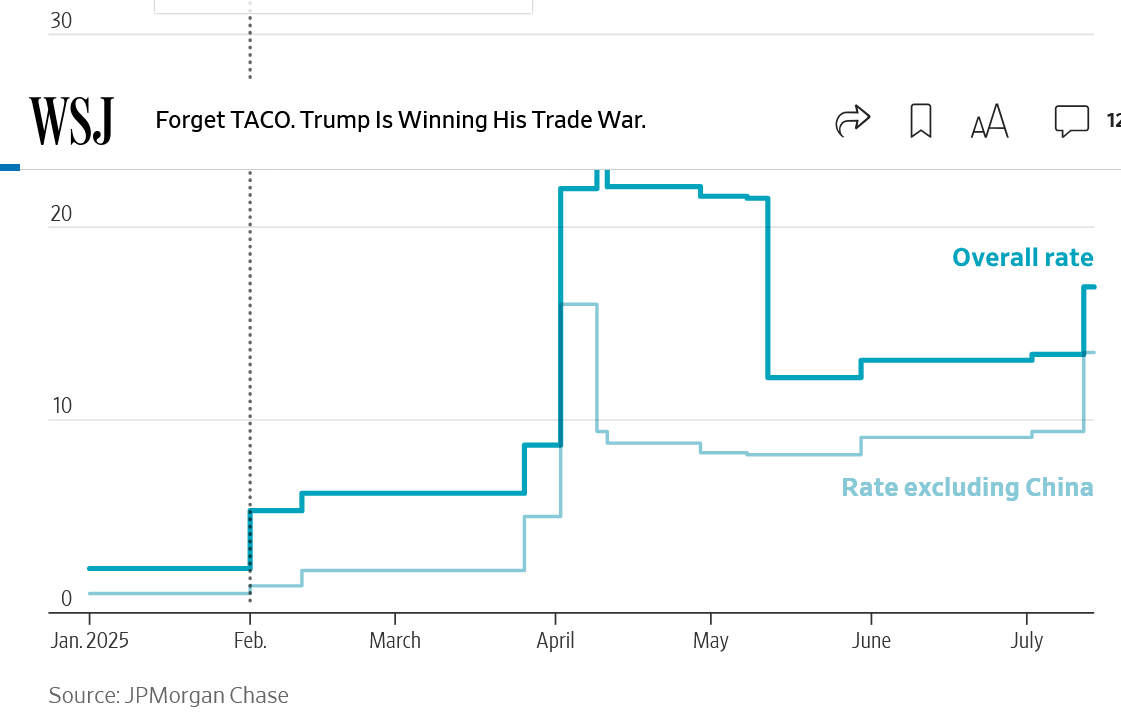
In June alone, Treasury collected $27 billion in customs revenue, up $20 billion from a year earlier, a pace that would imply $240 billion more a year. …
Including Trump’s tariffs on steel, aluminum and autos, the average effective tariff on all U.S. imports as of July 2 was 13.4%, according to JPMorgan Chase. That’s below the April 9 peak, but well above the 2.3% last year, and the highest since the 1940s, before the U.S. and its allies set up the mechanisms to bring down world trade barriers…
Trump claims the authority to raise tariffs on anyone and anything indefinitely for virtually any reason under the International Emergency Economic Powers Act, a law intended to sanction adversaries such as Iran or Venezuela. One court has declared his use of it illegal; that decision has been stayed…
For Trump, another disadvantage of deals is that in theory both sides are expected to abide by them. But Trump disdains such constraints and enjoys moving the goal posts. …
Much of the tariff money pouring into Treasury comes out of the pockets of American companies and consumers… [end quote]
The point of the article is that Trump is arbitrarily imposing tariffs unilaterally without crafting trade deals as previous administrations did.
The article doesn’t mention the August 1 deadline to raise tariffs even though that’s only 2 weeks away. The stock market is soaring based on TACO – the notion that Trump will chicken out and delay or change his mind about the upcoming tariffs.
According to Google Gemini, the tariffs due to come into effect on August 1, 2025 are:
Here’s a summary of the key tariffs due to be implemented:
European Union (EU) and Mexico: A 30% tariff will be applied to all goods imported from both the European Union and Mexico. The stated reasons for these tariffs include long-standing trade deficits with the EU and concerns about drug trafficking from Mexico.
Copper Imports: A 50% tariff will be imposed on all copper imports, citing national security concerns and the aim to strengthen the domestic copper industry.
Various Other Countries: President Trump has sent letters to over 20 nations, informing them of new reciprocal tariff rates that will come into effect on August 1, 2025, unless new bilateral trade agreements are secured. These rates vary by country and include:
Canada: 35%
Brazil: 50%
Japan: 25%
South Korea: 25%
South Africa: 30%
Kazakhstan: 25%
Laos: 40%
Malaysia: 25%
Myanmar: 40%
Tunisia: 25%
Bosnia and Herzegovina: 30%
Indonesia: 32%
Bangladesh: 35%
Serbia: 35%
Cambodia: 36%
Thailand: 36%
Philippines: 20%
Brunei: 25%
Moldova: 25%
Algeria: 30%
Libya: 30%
Iraq: 30%
Sri Lanka: 30%
It’s important to note that these new tariffs are in addition to any existing sector-specific levies, such as those already in place on steel, aluminum, and certain vehicles. The EU, in particular, has indicated that while they prefer a negotiated solution, they are preparing countermeasures if a deal is not reached by the August 1st deadline. [end quote]
I asked Google Gemini to calculate the amount of tariff that would be collected based on current trade volumes. The amount was $566.36 billion. Clearly the volume of trade will diminish due to the tariffs but that’s the first rough estimate and the actual amount collected will be lower.
Retaliatory tariffs could harm U.S. exporters and damage the economy.
Import tariffs will come out of the pockets of consumers and importing companies. This is both inflationary and damaging to profits. The only beneficiaries would be the government and American manufacturing companies which will raise their prices to match their importing competitors’.
Tariffs have already increased significantly but that’s just a small part of the tariff situation that could develop in the later half of 2025 and 2026. It will take time for manufacturers and retailers to work through their pre-tariff inventories. Then inflation will really take off.
Wendy