Hello Everyone!
Brief preamble as this is my first post on the board. Very thankful that the restriction on posting has been lifted. I’ve been an avid reader (literally check every day) of Saul’s Board since 2019 when my Dad first introduced it to me. I was in college at the time and took an interest in investing, specifically concentrated hypergrowth investing. We talk about our portfolios very often. I am grateful that my Dad showed me this amazing forum and that I have been able to absorb the wisdom from all of the contributors here over the last 7 years. I love reading about the companies, tracking how they perform earnings report to earnings report, and the competitive nature that comes with trying to beat the market.
Back in Summer of 2024, I decided to try my hand at writing my own monthly portfolio reviews. I would post them on Twitter and send them to my friends, but was unable to post them here. Once I found the Growth Investing Reddit I started posting them there too. Now that Saul’s Board is open again, I am excited to share and converse with everyone here now too. With all that said, here is my review for the month of October 2026.
October 2026 Portfolio Review
Bloody red. That’s the only way to describe the month of October for my portfolio. Not only was this the single worst month I’ve ever had since I began investing, but I also compounded my mistake by increasing my margin from 110% to 123.4% at the start of the month, just after $MU’s blowout earnings on the last day of September.
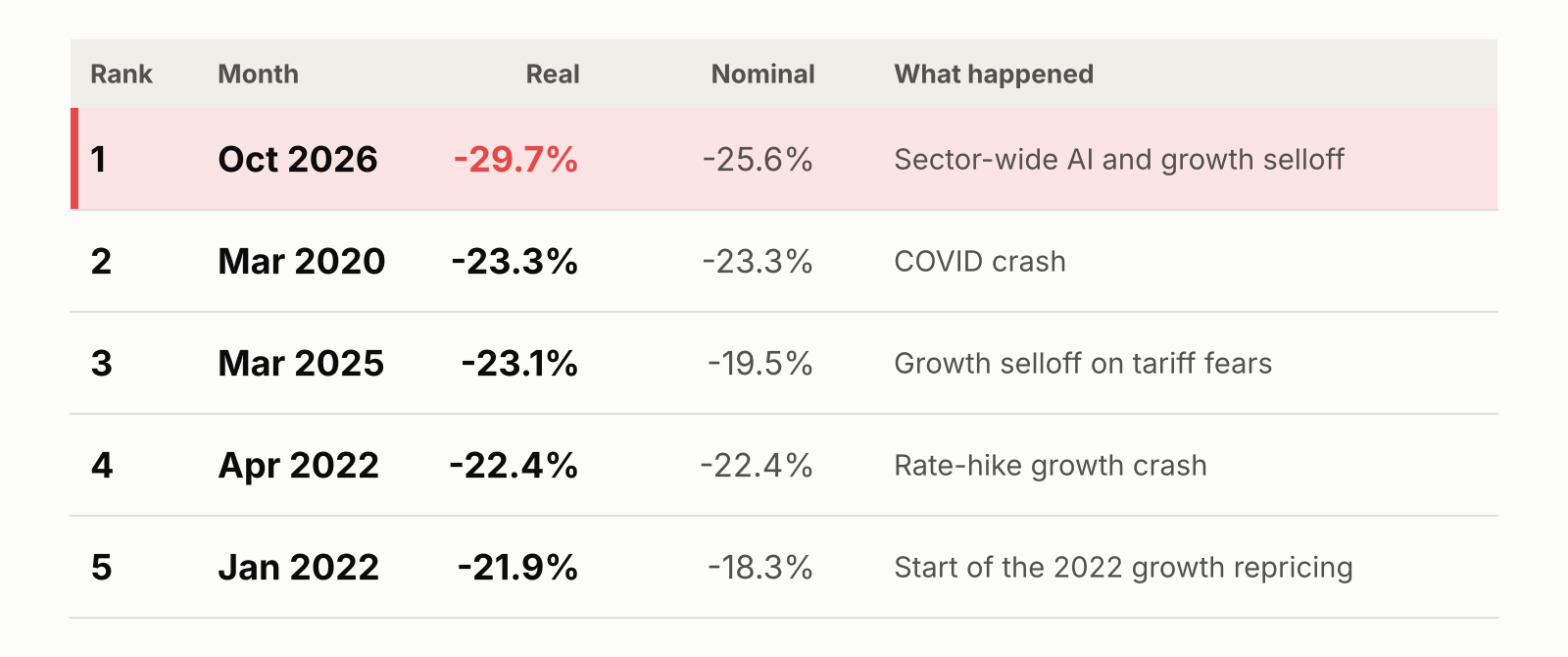
Timing has never been my strongest suit (which is why I try to avoid it by remaining fully invested), but apparently the powers that be decided now was the perfect time for a massive AI selloff. So how bad has this selloff been? I saw a graph earlier today that shocked me.
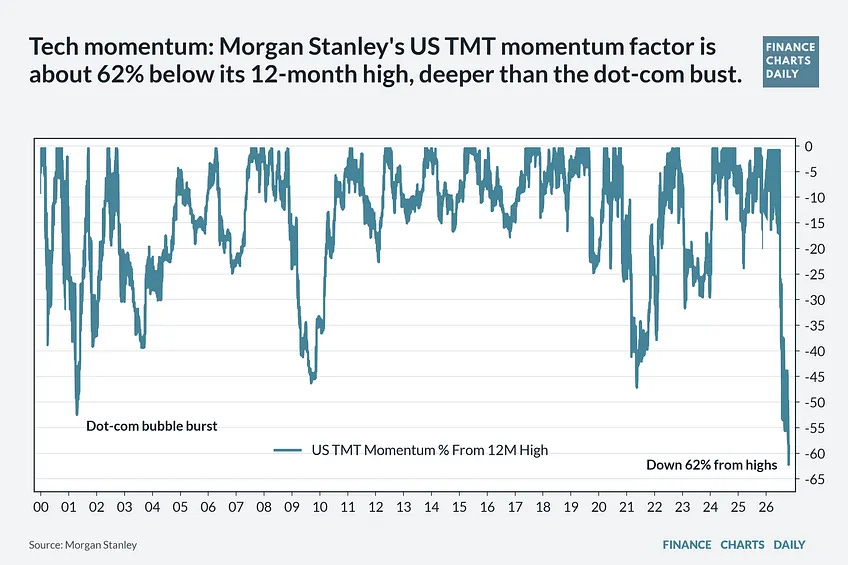
Source: Morgan Stanley, via Global Markets Investor on X (Oct 26, 2026)
Morgan Stanley’s TMT (Technology, Media & Telecom) Momentum Index peak-to-trough drawdown through October 2026 represents a worse crash than any one pullback that occurred during the historic Dot-Com Bubble. Worse than the Global Financial Crisis too. Read that again… This drop off was steeper than some of the worst market crashes of the last 30 years.
Yet despite all of the pain this month, I am still just as confident in my portfolio as I was before the abrupt contraction from all time highs. I find that it helps to zoom out and see when the last time my portfolio was at this level. May and July of this year. Not too bad when you look at it like that  . In fact, I wasn’t bothered at all by the price action until the latest two-day drawdown on the last trading days of the month. Putting my finger to the wind, I’m using that uncomfortability as a sign that the bottom is near. There might be another leg down or two, but personally I think we’re close.
Let’s shift back to my actual portfolio and the changes I made this month. Apart from adding to my $MU stake with margin, I completely sold out of both my $CRWD and $SNOW positions to double my $ALAB, add a little to $NVDA and even more to $NBIS near the middle of the month. Trimmed a little $NET and halved my $RDDT position after their earnings as well.
Nominal is pure % change, Real takes into account contributions made.
Monthly Gain: Down 25.6% Nominal // Down 29.7% Real
Yearly Gain: Up 30.3% Nominal // Down 1.7% Real
All Time Gain (from 2019): Down 3.9%
$NBIS // Down 33.2% // 54.9% Allocation
Nebius is an AI cloud company that builds and runs their own vertically integrated AI stack which includes GPU bare metal infrastructure, rentable Nvidia compute, managed inference through Token Factory (where AI models can be trained), and developer tooling for AI labs and enterprises.
As of Q2 earnings, Nebius sits at $1.36B in TTM revenue (up over 500% YoY) with guidance of $3.0-3.4B for 2026 and a $7-9B exit run rate, and $40B+ in contracted backlog. Those numbers are amazing. Just what you look for in a growth company. But the insane part is that their market cap currently sits at just $42B… After a 50% decline in stock price from their all time high, they are now valued at 13x their 2026 guide ($3.0-3.4B), 3.8x consensus 2027 revenue, and only 2.0x consensus 2028 revenue. For context, boring mature software companies trade at 5-8x, while fast growing companies can trade at anywhere from 10-40x depending on the market mood. And when you are a growth investor who seeks out companies who continuously beat their own estimates and raise guidance after that, that sets up an irresistibly juicy risk/return proposition.
Much of Nebius’ decline this month was due to a shift in sentiment regarding the AI buildout as a whole. With a rise in bond yields, the market turned its eyes towards the debt some of these companies are taking on and the cost that this massive buildout will need. All of a sudden, there is new fear that liquidity markets will become and remain tight for the foreseeable future and that these companies won’t have as much access to capital as was previously assumed. While this is certainly a consideration and part of the bear case, Nebius was, in my opinion, unfairly grouped together with its peer CoreWeave, who has a much more risky debt profile. CoreWeave is borrowing a lot more as a percentage of their projected revenue than Nebius and at worse rates. Part of Nebius’ advantage comes from their decision to finance a decent percentage (35-45%) of the buildout through customer prepayments. Nebius also has more cash on hand ($8.04B vs $5.5B).
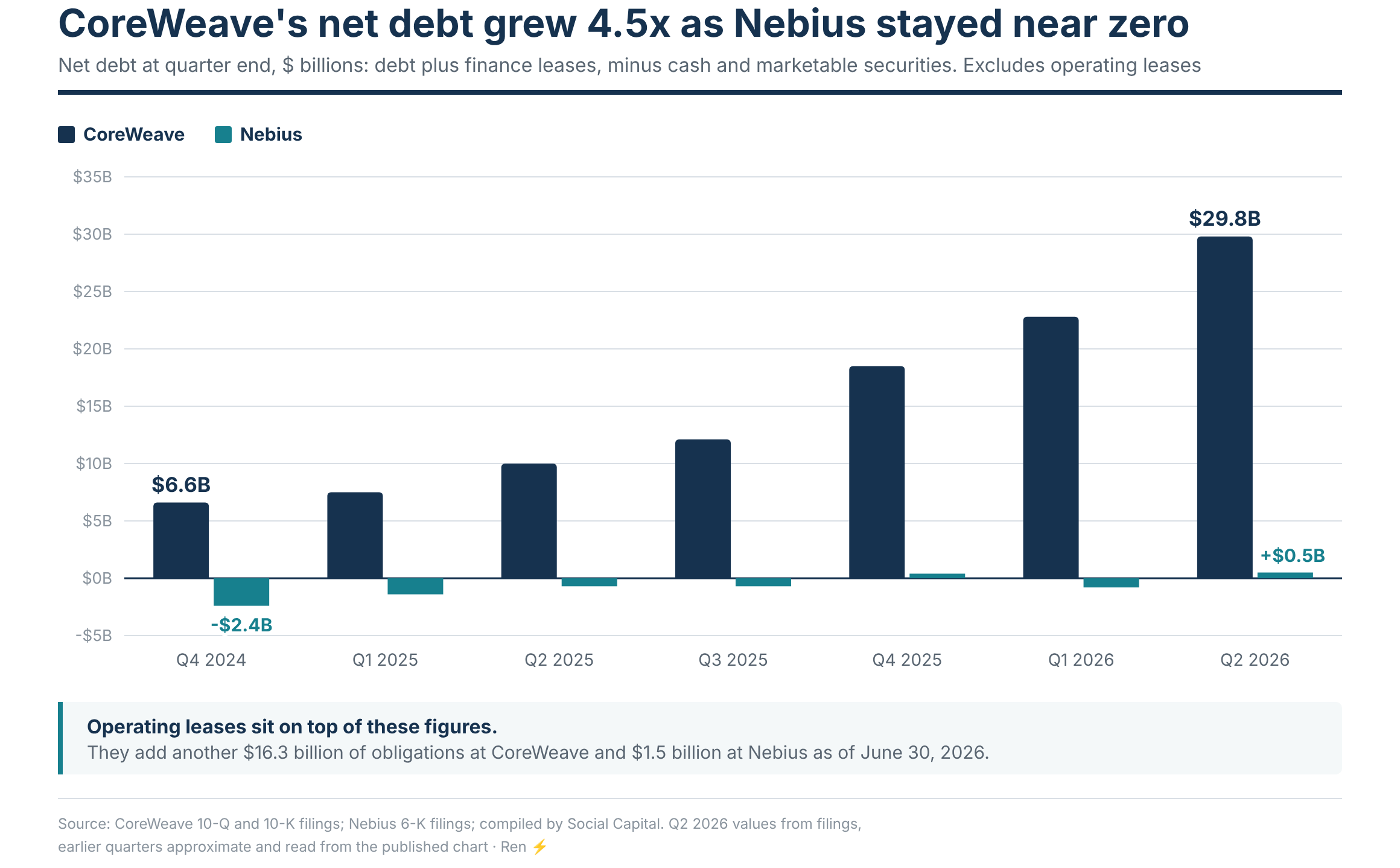
Source: CoreWeave 10-Q and 10-K filings; Nebius 6-K filings.
When it comes to actual news/announcements in October, per usual, it was nothing but positive confirmation that this is indeed a well-positioned company in an exploding sector. On 10/1 they acquired Inferize, which will bolster their Token Factory by reducing idle GPU capacity and improve utilization as AI workloads scale. This will cut AI model loading times from tens of minutes to seconds, solving the “cold start” problem, thereby improving gross margins and ultimately fulfilling more token requests due to time saved. This is another example of Nebius’ management team thinking ahead as it continues their tendency to absorb and integrate software talent and tech into their full AI stack offering.
On 10/21, they rolled out public live spot pricing for GPU compute with reserve auctions and pay-as-you-go options, they began a capacity rebate program for returning unused GPUs, and expanded their AI Builder Program with an additional $10M in compute grants. The same day, Nebius leadership publicly pushed back on the neocloud business model FUD, saying AI compute prices are rising. Demand is still very very strong. One bear argument is that GPU rental prices will collapse as supply arrives. There is no sign of that occurring at this point in time. What matters most is execution and the speed at which they can go from contracted power to connected power. This has always been the key determining factor for this investment to pay off and I am just as confident as ever that they will be able to succeed.
Then on 10/22, they announced a one year bridge contract of $3.5B senior secured facility from Citi, a next step towards funding their capacity buildout using diverse capital structure. Nebius said more, bigger asset-backed loans are still to come. This type of capital raise gives them the optionality to not finance through dilution as that would be detrimental to shareholders, particularly during a drawdown. But at the same time, a one year contract creates some uncertainty beyond 2027 with the ongoing tightening of liquidity.
Earnings are scheduled for 11/12. Needless to say this is a pivotal moment for the company and my portfolio. This is the quarter where the $7-9B ARR exit targets need actual numbers to confirm they are on track. Based on all available information, I am confident in Nebius’ ability to exceed the market’s expectations.
$MU // Down 18.4% // 29.3% Allocation
Micron is another major player in the AI buildout. They are the only American memory manufacturer and provide essential products including DRAM, NAND flash, and HBM. Along with their oligopolistic counterparts, SK Hynix and Samsung, Micron is feeding the single tightest bottleneck in the AI buildout: HBM, which is now 30-40% of total AI accelerator manufacturing costs.
Micron’s quarter at the end of last month was the catalyst for my margin moves, so it should be no surprise that they are my second largest position behind Nebius. They ended FY26 with $133.2B in revenue, up more than triple from the year prior and had $86.8B in net income. Historically, memory has operated in cycles where P/E valuations peak at the bottom and valuations are lowest at the top. High demand is accompanied by a subsequent flooding of the market and abrupt commodification of prices. The bet here is that the buildout and demand for memory is different now than it has been in the past and that the sector is either 1) no longer cyclical or 2) that the current cycle will last a lot longer than expected. Market cap is currently about $1.0T, which is around 11-12x TTM earnings and 5x Forward earnings.
Micron is absolutely printing cash, bringing in $230M every day. One way for them to put that cash to use is through share repurchase agreements. On 10/8, the Board approved a $35.16B buyback, which is on its own almost the size of Micron’s FY25 revenue for the entire year. Then on 10/15, there was some discussion going around about China’s CXMT, becoming an emerging player in the space. Increased competition and disruption to the current oligopoly is something to watch, but it hasn’t impacted the numbers yet so I am not concerned. It was a pretty quiet month for news, but lastly SK Hynix reported record results on 10/28 and forecasted continuing memory shortages through 2030. That is insane levels of demand. Four more years of price durability. Although it should be noted that almost all of Micron’s revenue explosion recently has been purely due to price and demand. Actual supply volume has not grown very fast, with growth remaining in the single digits.
I own Micron because of the clear growth story. It is a simple bet that the market is wrong about the past cyclical nature of the memory sector and are mispricing one of the most essential bottlenecks in perhaps the largest infrastructure buildout of all time. Demand is through the roof, extending years out already, while the valuation makes the risk/reward proposition even more intriguing.
$NVDA // Down 11.3% // 17.4% Allocation
Nvidia is the biggest cog driving the AI machine right now. They design the GPUs that act as the compute engine for the buildout, and own the networking, CPUs, and software stack that ties the ecosystem together. Hyperscaler CapEx, neocloud buildouts, and sovereign AI programs all need Nvidia.
Nvidia’s numbers are truly ridiculous with $303B in TTM revenue (up 83% YoY) with $193B in net income. Unprecedented at this scale and probably the most important company in the world right now. Yet somehow the stock price has barely budged in the last calendar year and it has a lower valuation than the S&P 500 as a whole with 26x TTM P/E and 17x Forward P/E versus 19x Forward P/E for the S&P.
On 10/22 at the GTC (GPU Technology Conference) Berlin they spoke about a headline product, DSX POD, a factory-built Vera Rubin AI factory in a container. That is, a full-stack already integrated and pre-tested to cut delivery and deployment from months to days. This could help address the current time-to-power bottleneck the buildout is experiencing. They also launched the OpenShell Reference Architecture so Vera Rubin, Vera CPUs, and BlueField-4 power enterprise infrastructure to build, run, observe, and enforce safe agents at industrial scale, plus a supply-chain capacity expansion with partners covering substrates, packaging, testing, and optical engines. Nvidia also expanded their European investments with over $10B over the past year and 14 startup investments announced during the conference. Nvidia is quickly becoming a major venture capital firm in its own right as they put their financial fingerprint across the industry with these types of investments. Autonomous vehicles was also a topic of conversation as they expanded a partnership with Mercedes-Benz to explore just that.
On 10/21, Huang also publicly confirmed that neocloud demand is “off the charts.” A bullish signal for my other positions in the wake of a massive selloff that has most people second guessing their portfolios. Google Cloud also announced Vera Rubin is now available, meaning revenue is now underway from Nvidia’s latest new product cycle, while Blackwell, the older generation of products, is still seeing demand exceed supply. Then on 10/27, they announced plans to expand OCI Superclusters with Vera Rubin NVL72 systems to multi-gigawatt scale, and to bring the Vera CPU to Oracle Cloud Infrastructure.
Until the strong numbers Nvidia keeps putting up start to show some weakness, they will remain a central position within my portfolio. Revenue is massive, valuations are relatively cheap, and I view this as one of the safest companies to own right now. Nvidia reports earnings on 11/17.
$ALAB // Down 25.1% // 12.2% Allocation
Astera Labs designs the connectivity silicon inside AI servers. That includes the retimers (Aries), smart memory controllers (Leo), and fabric switches (Scorpio) that move data between GPUs, CPUs, and memory at the speeds rack-scale AI requires. They are the “wires” that connect everything. Faster accelerators and denser racks require Astera Labs’ products for faster data movement. Their chips sit next to Nvidia, and inside hyperscalers’ racks as well, without competing with either so they are well positioned within the AI stack.
Revenue is accelerating at breakneck speed. They have $1.2B in TTM revenue (up 104% YoY) and guided to a 40% sequential increase (QoQ) from last quarter to this upcoming one. They have 75% gross margins as well. While Astera is the fastest accelerator in my portfolio, their valuation is admittedly very high. It gets better when you look forward but at $45B market cap, they trade at about 38x TTM P/S. On forward revenue it is more reasonable, but still elevated at about 24x Forward P/S.
On 10/8, Astera launched Aries 7, the industry’s first PCIe 7 signal conditioning portfolio across copper and optical interconnects with purpose-built retimers, redrivers, cable modules, optical drivers, and optical TIAs. The company has a pattern of innovation and are the first to market with this product. Astera is posturing to keep its position in the market when the industry transitions to optics rather than losing it to optical specialists. On 10/12, they unveiled Orion, a compute-agnostic rack-scale architecture for token-efficient AI factories. ‘Compute-agnostic’ being the operative phrase. Orion positions Astera as the connectivity backbone for any accelerator (Nvidia, AMD, or hyperscaler custom ASICs), which is a hedge on Nvidia pulling more connectivity in-house with NVLink. Astera is betting the custom silicon wave (Trainium, TPU, etc.) needs a merchant rack architecture, and it wants to be that standard. Then at the OCP Global Summit they along with Corning and Lumentum, demoed, 1060 nm VCSEL-based PCIe over optics for AI rack-scale connectivity, a proof of concept for the optical transition.
I took advantage of the recent downturn by doubling my Astera Labs position using proceeds from my Snowflake and Crowdstrike sales. I trimmed pretty heavily over the last few months due to valuation concerns, but with their new Scorpio product line expected to be their largest driver of revenue yet, I can see the already high expectations being exceeded in the future. They are underratedly well positioned in the AI stack too with the ability to work alongside many of the other major players rather than competing against them. Also, unlike Nebius and Nvidia, they don’t need to spend as much on CapEx, which is a nice differentiator. As the fastest growing company in my portfolio, accelerating 40% QoQ, I am happy with my current allocation. Earnings are on 11/3.
$NET // Down 20.0% // 5.3% Allocation
Cloudflare operates a global edge network that sits between the internet and roughly a fifth of all websites, selling security (DDoS, zero trust), performance (CDN, DNS), and increasingly a serverless developer platform (Workers). They act as a “connectivity cloud” and are taking advantage of the new AI-centric world as bots now outnumber human activity online. They are the ones who authenticate, meter, and monetize that traffic while their edge network serves as the deployment platform for AI applications. True to their track record, Cloudflare is innovating quickly and strategically.
Cloudflare has $2.51B in TTM revenue (36% YoY) and saw growth re-accelerate. This acceleration paired with 77% gross margins is very encouraging. The main concern, and reason why I trimmed this month, is valuation. Their market cap is $100B and they trade at 40x TTM P/S and 27x Forward P/S. By far the richest valuation multiple in my portfolio now even beating Astera Labs forward multiple. What you pay for is revenue durability. They’ve had consistent 30%+ revenue growth (briefly 27-28% in late 2024) every quarter since I began investing in them nearly 6 years ago!
On 10/12, they acquired Deno, the open-source JavaScript/TypeScript runtime, to improve the Workers programming model. This helps deepen their moat by pulling the JavaScript ecosystem towards Cloudflare’s edge. On 10/20, they announced a developer milestone that more than 10M developers are now building on Cloudflare. That number was 7.4M last quarter so an increase of 35% QoQ. Much of this was actually AI agents using Workers and if agents default to building on Cloudflare, the developer platform becomes a very strong growth engine. Then on 10/28, they announced a few agentic commerce partnerships with Commerce.com and BigCommerce so AI agents can transact directly on merchants’ sites inside the browser. They also added new Cloudflare OS AI integrations. The commerce partnerships are one example of how their agent thesis will be monetized.
Cloudflare is a stalwart of my portfolio. Even though I’m only keeping a single digit allocation, I can definitely see adding more if the valuation drops. As the longest lasting SaaS company in my portfolio now that Snowflake and Crowdstrike are gone, I can’t help but feel a little nostalgic about them too. Their pivot into AI has been encouraging. Management is top tier as always. Cloudflare reports on 11/5.
$RDDT // Down 38.2% // 4.3% Allocation
Reddit is the internet’s largest network of interest-based communities, monetized through advertising and, increasingly, data licensing to AI labs. Its position in the ecosystem is double-edged: it’s one of the last sources of authentic, human-written training and grounding data (hence the Google/OpenAI licensing deals), while simultaneously being exposed to AI answer engines intercepting the search traffic that historically delivered its logged-out users.
They reported earnings on 10/29 and I was definitely left wanting… While the actual revenue numbers were great at $895M this quarter, $3B TTM revenue (53% YoY), they had their smallest revenue beat at just 2%. Historically they had beat guidance by 6-8%+ so this was the first yellow flag. Gross margins of 91.5% is the best in my portfolio. Every dollar they make in sales comes back to them almost entirely. The valuation is a bargain with a market cap of $18B, 5.9x TTM P/S and 4.0x Forward P/S. But unfortunately, real cracks appear when you take a closer look at their overall user growth of 12% YoY. They missed street estimates on all accounts. Global DAUs (-2.3%), US DAUs (-4.8%), International DAUs (-0.6%), and Global WAUs (-3.0%). Their US DAUs actually declined 2% YoY. The metrics are broken out by logged in vs logged out users. US logged out users declined -4% which is a byproduct of negative Google referral changes, while US logged in users increased by only 1% YoY. The most monetizable cohort isn’t growing. Management even warned that low double digit DAU decline could occur in the next quarter if current search referral trends continue. On the other hand, their ARPU (average revenue per user) continues to grow (up 36% YoY), so of the users they do have, they’ve been able to monetize them effectively. They also have plenty of cash with $3B in reserves. But this was not enough to save them as revenue guidance for Q4 was $1.15B, slightly below estimates. Meaning their beat and raise streak has ended.
During earnings, management reframed Reddit’s future as a logged-in experience, so it seems that to counteract the data scraping and search referral war against Google, they are focusing on monetizing their current users and protecting their data from bots. I still think there is underappreciated value in their data and that they can use their position to their advantage, but it is disappointing to see them lose on the user growth front.
My time owning Reddit has been interesting. The perpetually low valuation and honestly superb growth rates and margins is why I invested in the first place. They have a unique place in the AI space as well with their valuable human data that comes from the communities on the platform. After earnings I ended up trimming half of my position, but I am still holding a small allocation due to the upside I see if they can monetize their data with AI and potentially turn around the user growth story. The valuation is also keeping me in. But if they have another quarter or two like this and revenue doesn’t appear to be durable, I will think heavily about selling. Numbers over everything first and foremost.
$CRWD // Down 5.9% // SOLD
Crowdstrike is the leading AI-native cybersecurity platform. Its flagship product line, Falcon agent sits on endpoints and now extends across cloud, identity, and AI agent security, selling consolidated security modules on a land and expand model. In the current ecosystem it’s riding a second narrative wave. As enterprises deploy AI agents, someone has to secure them, and CrowdStrike has positioned Falcon (plus the Nvidia partnership) as the security layer for the agentic era.
Crowdstrike grows slower than my other holdings with $5.4B in TTM revenue (up 26% YoY). Their market cap now sits at about $258B or 48x TTM P/S and 36x Forward P/S. Very elevated on less than 30% growth.
On 10/7, they were named a Leader in the 2026 IDC MarketScape for Modern Endpoint Security. There were some breaches this month that highlighted the increased need for cybersecurity and I don’t see those news stories stopping any time soon. AI is finding vulnerabilities, but through companies like Crowdstrike, they are patching them as well. On 10/22, they also expanded their Nvidia collaboration on AI agent security.
Selling out of Crowdstrike is a product of two main things: 1) It hadn’t fallen as much as some of my other holdings and I wanted to reallocate into places I had more conviction and 2) it has a higher valuation and slower growth than my other holdings. I really love this company and admire their growth since I started my first position about 7 years ago. I also really appreciated having them as a hedge on AI as a traditional SaaS firm. They also diversified my portfolio as my only pure cybersecurity play. I definitely expect to buy back in at some point if valuations fall. I think they could accelerate revenue substantially due to the increased importance of cybersecurity in the age of AI.
$SNOW // Down 10.9% // SOLD
Snowflake is a consumption-based platform where enterprises store, process, and share data across clouds, now layering AI products (Cortex, Snowflake Intelligence) directly on top of customer data.
Encouragingly, because of AI, growth has reaccelerated for three straight quarters as those AI projects move from pilot to production. They did $4.68B in TTM revenue (up 37% YoY), have 75% gross margins, and trade at a $108B market cap. This equates to about 23x TTM P/S and 17x Forward P/S. Decent enough valuation. Especially compared to where this company was at IPO launch. Very solid business metrics.
On 10/1, Snowflake closed an upsized $3.75B private placement of 0.00% convertible senior notes. Interestingly, it appears that they are also getting in on the AI buildout and acquiring capital to do so for the data-software layer. On 10/5 at Expedition 2026 they announced dynamic model routing in Cortex AI Gateway, the ability to automatically select models by quality, speed, and cost per task, and had Satya Nadella headlining the conference speaker list. Snowflake is positioning themselves as the neutral broker of AI models over enterprise data. The routing layer that commoditizes the model providers rather than being commoditized by them. They also announced a few distribution partnerships with Lumen on private data connectivity and Oracle expanding native AI and data services on OCI with Snowflake. It’s good news that Oracle, the fourth cloud, is treating Snowflake preferentially.
While growth is accelerating and is above the level that Crowdstrike was at when I sold them, I decided to sell out here too. Predominantly because of the first reason I gave before for Crowdstrike: there are places I have more conviction and Snowflake’s stock price didn’t dip as much as those other places that I wanted to concentrate into. I can definitely see myself restarting a position in the future, but for now the consolidation of my portfolio into my strongest conviction continues.
Macro:
The macroeconomic environment was the story of October 2026. The AI sector, which is where I am almost entirely concentrated, took the worst of it. The market rotated out of my stocks and into other areas of the economy like energy, dividend, value, and real estate stocks. It happens sometimes. The amount of FUD ongoing right now in the face of excellent business performance is actually insane. People like to dissect a downturn while it’s happening, often assigning causality that they think makes sense after the fact. I’ll do the same and lay out all the uncertainty that makes up the juxtaposed backdrop as I see it.
The first major event came on 10/7, with the 10-year Treasury yield hitting 5.365%, its highest level since April 2002, with the 30-year near 5.69%. These elevated yields were driven by inflation that won’t go away, a rate hiking Fed, and roughly $10 billion per business day in net Treasury issuance. Then on 10/14, CoreWeave’s stocks and bonds were both hit as investors became fearful about all tech companies’ plans to finance the $3.5T AI buildout through debt. That same day a Gartner report came out that stated more than 80% of neocloud providers could stop operating independently by 2030. This was more speaking to consolidation than bankruptcy, but the market still got spooked. Paired with still rising oil prices due to the avoidable and prolonged Iran War, the macro backdrop was fearful. Additionally, some people are scrutinizing Anthropic’s revenue disclosure. Unfairly in my opinion, but they reported an absurd 1,368% YoY revenue growth in Q2, along with future spending obligations that dwarf that revenue by an order of magnitude.
Apart from all that, there was also uncertainty related to the midterms. Some investors think that if Democrats sweep both the House and the Senate, that AI buildouts will be disrupted. I think that, while there is plenty of posturing and anti-data center sentiment, I do not believe this would meaningfully slow down any progress. Really what they are arguing for are safeguards. Insurance that communities will not see rising energy prices or be negatively impacted by the AI buildout without their consideration of the benefits and costs. My own personal theory is that the market is also pricing in the likelihood that Trump and Republicans will refuse to seat Democrats who win their elections in another fake-electors style insurrection attempt that mirrors 2021. Haven’t seen anyone talk about that, but it’s another huge unknown how it will unfold and may have far reaching mostly non-economic consequences.
A large part of me believes this is a shakeout to get retail to sell to the big funds before we go parabolic. I mentioned the “coiled spring” last month, but I truly believe we are about to see some bonkers growth numbers over the next few years as this buildout ramps up. With Anthropic filing its public S-1, potentially becoming the largest IPO in history valued at $1.5-2T, I can easily see this rotation as a way to get better prices before the market explodes upward…
Capital is expensive, which puts CapEx at risk of falling behind schedule. Some people shout loudly that the bubble is popping, but this does not feel like a bubble to me. Bubbles rarely inflate when everybody thinks we’re in one. The Dot Com Bubble valuations spiked insanely high on zero revenue. They built the internet infrastructure expecting demand to come later. With AI, the demand is already here and it can’t be served fast enough.
I firmly believe we are early in the AI revolution and will look back at this downturn as an excellent buying opportunity. Despite the blood across my portfolio this month, I am just as excited as ever for my holdings.
Final Portfolio (123.4% Long)
$NBIS 54.9% 
$MU 29.3%
$NVDA 17.4%
$ALAB 12.2%
$NET 5.3%
$RDDT 4.3%
$CRWD SOLD
$SNOW SOLD


