$EOSE manufacturer of grid scale zinc bromide batteries

I’ve taken a starter position in $EOSE. This writeup is not going to be as comprehensive as I would like, because I’m preparing for a trip and am still trying to wrap my head around all the moving parts. They’ve guided full year 2025 revenue to between $150M to $190M, compared to only ~$16M reported in full year 2024. Analysts are projecting revenue of $477M in 2026 and $1B in 2027. They are ramping production of their proprietary Z3™ battery technology, an aqueous zinc battery system offering a non-flammable, fully recyclable, and long-duration alternative to lithium-ion, with safety and lifespan advantages suited for grid-scale and renewable integration. These batteries are being manufactured in Pittsburg with >90% USA based supply chain. They have been incentivized by both the Biden administration’s Infrastructure Bill ($303.5 million DOE loan guarantee closed in December 2024) and are eligible for the Trump Administration’s BBB fully stackable Section 45X production tax credits.

The 2024 financial report was subject to a “going concern” opinion, but a number of financing transactions that are disclosed in the Q2 2025 earnings transcript make it clear that there is no longer any question of it not being a going concern. More importantly, they ended Q2 with a pipeline currently valued at $18.8 Billion and a backlog of $672 million. I was initially repelled by its historic losses, but I now think most of that is rear view mirror, and what lies ahead looks decidedly favorable.

There is a rather accomplished group of investors in an X sub-thread dedicated to EOSE, but @Bert_Gilfoyle is clearly the most knowledgeable. He has hosted a number of X Spaces over the last few years that add color. Here are links to the two most recent:

https://x.com/i/spaces/1LyxBgeOYzWKN

https://x.com/i/spaces/1eaKbaLrkXnxX

The $EOSE manufacturing facility in Pittsburgh currently has one fully automated production line and the second line is expected to be operational in the first half of 2026. All told this factory will eventually have 4 fully automated production lines running 24 hours a day, each line capable of producing between 2.25Gwh and 3Gwh per year depending on the assumptions. Some back of the napkin math: At a production rate of 2.25gwh, once all 4 production lines are operational (projected to be in 2027 or 2028), there should be about $2B per year in revenue, which should generate roughly $700M in EBIDTA which should equate to roughly $4 per share in fully diluted EPS. Management is already scouting locations for a second factory with an additional 4 production lines.

As I’ve said, this is just a starter position for me. I’m eager to have others poke holes in the investment thesis to see if the bull case holds up to scrutiny.

33 Likes

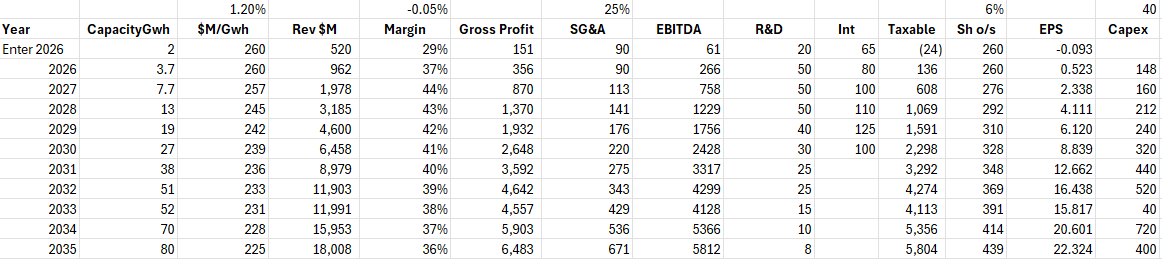
This is a spreadsheet adapted from X source @OldMateEngineer. I’ve not vetted this, use only for illustration purposes. My take is that the relationships are roughly accurate, but not necessarily timing.

6 Likes

This is my feedback. First, I do my own valuations and go out maybe 3 years, because that is how far out the analysts go. The world is changing very very fast, so I don’t think anyone can go out 10 years with accuracy. Also, the price/sales is 77, so I think it is too expensive.

4 Likes

I found your first post very interesting. I have a position in ELVA. They are a competitor using lithium-ion technology. This zinc based technology seems to offer several advantages. Mostly, it is a much more stable chemistry which makes these grid scale batteries considerably safer - that’s an assertion based on comments made during the 2Q25 quarterly conference call.

So now I have positions in both ELVA and EOSE. I’m of the opinion that the TAM is big enough to support several providers of electrical storage systems. I anticipate that there will be additional players in this field, but eventually there will be a shakeout with only a relatively small number of winners. First to market have an advantage. It’s not unlikely that both of these companies will be among the survivors.

To be honest, this product and market is way out of my wheel house. I know next to nothing about large capacity electrical energy storage (I think energy is what gets stored - maybe it’s power - whatever). What seems to be true is that with the demands for electricity due to the incredible build out of AI, HPC, Crypto mining and other computing resources is immense.

The grid (at least in the US) is antiquated, much of it was built in the 1950s and earlier. In its current state, a great deal of electrical energy is wasted. It is pretty much a 20th century implementation of 19th century concepts about electrical distribution. Westinghouse was the principal industrialist responsible for the engineering of the system. He beat out Edison by convincing the political leaders who wished to electrify their jurisdictions that alternating current was the only viable solution (Edison’s solution was based on direct current). The claim that AC is superior to DC is debatable, but George’s argument was compelling. Of course, there’s been some modernization, but conceptually the system we have today has not changed a great deal.

There was no thought given to storage of excess capacity. The plants that generated the electricity had no mechanism for matching supply with demand, as a result the supply often exceeded the demand resulting in the excess energy getting dissipated as heat.

While there are new infrastructure build outs, most of the existing infrastructure cannot be discarded - you can’t change the tires on a car careening down the highway. Basically, the new technologies such as incorporation of storage devices have to be retrofitted into the existing system. You can’t just put some batteries in a building and hook them up to the grid. Control systems have to be created in order to address the supply/demand requirements. Eos doesn’t only make batteries, they also provide software that runs the control systems with the goal of optimizing the efficiency of the entire system.

18 Likes

Thanks for making an individual thread to discuss EOSE.

I am very positive on the TECHNOLOGY. This type of aqueous electrolyte is safe, scalable and durable. All of these are very positive for grid scale installations where these assets will be collocated on other substation easements or right of way.

I am not so connected on the COMPANY. Every battery company wants to make proprietary solutions (or market them as the UNIQUE! NEW! UNDISCOVERED!). There is nothing that EOSE is doing that has a moat or is of significant value to a Utility scale business partner.

(There is value to the end user, but it’s a commodity value that boils down to simple financial NPV and depreciation)

In this case, we have a MARKET that is growing at a commodity driven level (MWH installed). All boats will rise.

Will this company rise at the rate that Battery storage is added?

Will this company gain significant operating leverage and excess margin for their products?

Will this opportunity be better/worse/similar to other, more asset light opportunities for my dollar?

I don’t believe the answer is a clear yes for any of these questions.

I DO believe there is an opportunity for value expansion (stock price appreciation) due to investor awareness and hype, however. ← This is not interesting to me.

No position at this time.

15 Likes
  • FlexGen Power Systems and Eos Energy Enterprises entered a Joint Development Agreement (JDA) in December 2024 to develop and commercialize a fully integrated, American-made battery energy storage system (BESS) solution. This partnership combines Eos’ Z3™ zinc-based long duration energy storage batteries with FlexGen’s HybridOS™ Energy Management System (EMS).

    Key aspects of the agreement include:

    • Joint commercialization and development of an integrated solution specifically designed for utility-scale, independent power producer, and large energy consumer applications.

    • The solution incorporates U.S.-manufactured batteries, inverters, and transformer packages paired with advanced EMS software, emphasizing domestic content and supporting American energy independence.

    • Both companies are leveraging their combined project pipelines, targeting a total addressable opportunity of over 50 GWh in the U.S. market.

    • The partnership aims to reduce the complexity and cost of deploying grid-scale energy storage by providing a one-stop, streamlined product offering that ensures high reliability, performance, and U.S. supply chain compliance.

    The agreement reflects a mutual commitment to accelerate U.S.-based long duration energy storage adoption and support national renewable energy and security goals

With regard to a moat, EOSE does have patents. The most recent is discussed in this recording. Go to the 32 minute mark: https://x.com/i/spaces/1LyxBgeOYzWKN

9 Likes

Well done on the writeup!

From a product or narrative perspective the company sounds good with backup energy systems that will be useful for data center energy storage. It’s with the financials that give me some pause though,

While revenue is 15.2M +1597%, they had a gross margin of -203%, EBITDA of -61M and net income of -223M in the latest quarter. They are scaling up significantly in a years are projected to have 500M quarters. The issue I see is there can be a lot of blockers on the way to scaling up like that, and they haven’t proven their business model can be profitable yet.

I would prefer to wait here and see that the company can step up revenue and profitability before investing. There’s a pretty interesting thread from years back where I had started a position in Amprius AMPX back when they had a -150% gross margin. Saul was pointing out they would be a money losing machine, while back then I was more on the side of how compelling this story sounds. Now I am more likely to want to see a business model really working.

One of the reasons I like Electrovaya a lot is they are scaling up in the same industry but they are already GAAP profitable, and have 1/10th the valuation of EOSE. They might not be able to scale up as fast as EOSE, but they have already proven they can control costs while scaling. That gives me a lot more confidence that the economics of the business are already working.

I’ll add that I’ve had my eye on Amprius AMPX, and Enovix ENVX for a long time to see if either one of these companies can really deliver on their promises. So far it’s been a lot of project delays and issues with scaling up. I’d really like to see one of these companies like EOSE, AMPX, or ENVX hit scale and get above that 100M revenue line with reasonable profitability to have some confidence. I do believe energy storage systems are likely to have a bright future, I just want to see that play out in the numbers before investing.

35 Likes

@GDavenport Thanks for that observation - as I noted previously, the product and market are way out of my wheelhouse. I appreciate comments from someone who is at least somewhat informed, if not actually engaged in the field.

What it boils down to for me is that I had thought that the zinc/bromide chemistry was somehow unique and patentable. That was apparently a misconception on my behalf.

Now armed with that knowledge I’ll put a stop loss order on my position (I rarely use stop loss orders). The stock price was appreciating rapidly yesterday and closed at a price higher than what I paid for the stock. If a herd of ill informed investors (such as myself) continue to drive the stock higher, I’m certainly willing to take advantage of the situation. But, it seems inevitable from your comment coupled with the comment by @wpr101 that the bubble will eventually burst. I’ll let it run for now while protecting my rather small investment.

11 Likes

I’m away from home and attempting to work from my laptop. I’m not a chemist, nor a patent expert, nor an expert in batteries. Ask my wife, an she’ll confirm this and many other areas in which I’m lacking! But it doesn’t seem plausible to me that EOSE batteries have no patent protection. So I asked Perplexity to give me a summary of EOSE battery patents. As you can see, EOSE has quite a few patents, but that doesn’t mean they have an impregnable moat. But it’s not nothing, which is the sense I get from some of the comments here.

    • EOS Energy holds over 95 issued and pending patents focused on zinc hybrid cathode battery technology, mainly protecting advances in aqueous zinc-halide electrolytes, bipolar electrode structures, battery module design, and methods to improve durability, round-trip efficiency, and lifespan compared to traditional lithium-ion solutions.

      Core Patent Technologies

      • EOS’s patents include proprietary aqueous zinc-halide electrolytes engineered for enhanced stability, performance (Coulombic efficiency), and longevity, reducing unwanted chemical reactions that degrade battery life.

      • Many patents describe innovative bipolar electrode designs—using conductive plastic anodes and carbon-felt cathodes in non-degradable configurations—that lower internal resistance and support efficient charge/discharge cycles.

      • Patents also cover battery module architectures such as open pool, single-cell designs, and housing structures that simplify manufacturing and cell interconnections.

      • Electrolyte additives and deep eutectic solvents for zinc chemistry are protected for improved plating, solubility, and dendrite mitigation.

      • Eos has mechanical-chemical energy storage system patents for simultaneous gas compression and chemical-reaction-based heat recovery, which is also applied to battery system efficiency.

8 Likes

Yes, profitability is the crux of the issue, and largely why It’s just a tiny position right now. $130M of the losses incurred in Q2 is the fair value adjustment of outstanding warrants, which increase in value as the stock price increases. In addition, there was a one time $49M charge for early extinguishment of predatory debt. Because the stock price continues to move higher, there will likely be another big charge in Q3 and perhaps another in Q4 prior to the November warrant expiry, but these are non-operating, non-cash charges. But I don’t want to sugar coat this … analysts seem to think that it won’t be until 2027 that EOSE will be EBIDTA prositive. That may be overly pessimistic, but it begs the point that you raise … make them prove themselves before putting investment dollars at risk. Thanks for making that point clear.

9 Likes

@twillo Sometimes I just feel dumb. I just assumed that the EOSE technology was a commodity, just chemistry which can’t be patented.

But, in my defense, I’m currently in China and sites like Perplexity or even vanilla Google are inaccessible courtesy of the famous Chinese Great Red firewall. I am able to access Bing, but I can’t get it to speak English, everything is in hanzi (Chinese writing). So, I would not have been able to ask an AI about it. Nevertheless, it was imprudent of me to simply assume there was no patent protection whatsoever.

I’ll leave it at that. Anything I have to say about my actions is really not valid for this board.

6 Likes

A new Seeking Alpha article on $EOSE published by “First Principles Partners” with a $39 price target

3 Likes

Here is a summary of the DOE (Dept of Energy) milestone driven loan guarantee program:

The DOE loan guarantee to EOSE is a $303.5 million facility supporting the expansion of zinc-based long-duration battery manufacturing in Pennsylvania. The agreement permits up to four disbursements, each tied to specific project milestones, with 80% of eligible costs funded per tranche.

Key Terms

  • Maximum principal: $277.5 million, plus $26 million capitalized interest.

  • Maturity: June 15, 2034, with interest at U.S. Treasury rates plus 0.375%.

  • Use of proceeds: Construction and expansion of manufacturing lines for zinc-bromide battery systems (Project AMAZE).

  • The loan covers 80% of qualifying project expenses for capex and operational costs, including eligible costs to build advanced production facilities.

  • Scope may expand to two additional manufacturing lines, pending DOE environmental review and further approval.

Milestones Governing Disbursements

  • Loan disbursement is split into four tranches, each linked to the achievement of defined manufacturing milestones.

  • The first tranche was released upon completion and ramp-up of the first advanced manufacturing line.

  • Subsequent tranches are contingent upon successful production, maintenance, and operational benchmarks tied to each additional production line.

  • Each tranche funds a discrete phase: Line establishment, production ramp, order fulfillment, site expansion, and purchase orders for new equipment.

  • EOSE must demonstrate progress on capacity expansion and fulfillment of signed MOUs and purchase agreements to unlock further draws.

In summary, EOSE’s DOE loan guarantee is milestone-driven, with each loan tranche released only after proven manufacturing progress, successful commissioning of new lines, and fulfillment of operational benchmarks associated with Project AMAZE.

13 Likes

AMAZE stands for: American Made Zinc Energy; BESS stands for Battery Energy Storage System.

\

1 Like

This is from the EOSE Investors X Subthread

EOS Energy Enterprises: Pioneering Zinc-Based Long-Duration Energy Storage Investment Pitch - TL;DR version EOS Energy Enterprises ($EOSE) is entering its first year of scaled commercial operations with momentum across manufacturing, capital, and customer growth. Its Z3 battery—designed for safe, scalable, U.S.-made long-duration energy storage—is now being deployed at scale, with efficiency and installation milestones that significantly lower project costs. Backed by a DOE loan, strategic investment from Cerberus, and recent capital raises totaling $336 million, EOS is expanding production capacity toward 8 GWh and delivering on a $680.9M backlog and $15.6B pipeline. From data centers to grid peakers, standalone storage is driving new demand, and EOS is positioned to lead with a fully domestic, non-lithium solution. Long-form Pitch EOS Energy Enterprises specializes in zinc-based long-duration energy storage (LDES) systems, including standalone storage - critical for firming capacity and integrating renewable energy sources like solar and wind into the grid. With U.S. demand for LDES projected to reach 460 GW by 2050, EOS’s advanced zinc-bromine battery technology positions the company at the forefront of this rapidly expanding market. Technological Advancements and Manufacturing Milestones Building upon zinc-bromine battery technology initially developed by Exxon in the 1970s, EOS has secured multiple new patents over the past decade, enhancing various aspects of its battery systems. In June 2024, EOS commenced commercial operations of its first state-of-the-art manufacturing line, producing the Z3 battery - its first truly manufacturable, high-throughput design. The EOS Znyth™ aqueous zinc battery was designed to overcome the limitations of conventional lithium-ion technology. It is non-flammable, can be safely installed indoors and out, is scalable, efficient, quiet, and manufactured in the U.S. These attributes position EOS’s technology as a robust, safe, and proven solution for utility, industrial, and commercial customers with energy storage needs in the 3 to 12-hour range. The system is also well-suited for standalone storage deployments requiring long-duration performance and minimal degradation over time. Recent system-level milestones confirm Z3’s manufacturability and performance: EOS cold commissioned 75 cubes in just 7 days at a recent site - reducing installation costs by 96% versus prior designs. Z3 systems now achieve round-trip efficiencies above 80%, with some longer-duration configurations surpassing 90%. EOS Energy Enterprises joins the ranks of just four other U.S. companies recognized by Bloomberg New Energy Finance (BNEF) as a Tier 1 energy storage supplier. This elite group includes Tesla, Fluence, and FlexGen Power Systems. Powin Energy, formerly on the list, no longer meets BNEF’s criteria following its recent bankruptcy filing. Strategic Grid Applications Beyond Renewables In addition to its critical role in firming renewables, the Z3 battery is itself a fully dispatchable energy asset - capable of delivering multi-hour power on demand. EOS is also targeting standalone storage configurations that complement gas peaker plants - enhancing grid responsiveness, strengthening capacity, and improving the overall efficiency and flexibility of thermal generation assets. CEO Joe Mastrangelo has identified this application as a strategic focus area, further expanding the relevance of EOS’s technology across a broader range of utility use cases. Strategic Partnerships and Financial Growth Since going public in 2020, EOS has navigated capital markets and operational risk to secure critical funding from both private and public sources - positioning the company for scalable growth. In August 2023, EOS partnered with ACRO Automation Systems, a Wisconsin-based leader in high-speed, custom-designed manufacturing systems, to develop and deliver the company’s first high-throughput Z3 production line. ACRO played a key role in the successful launch of EOS’s first commercial manufacturing line in June 2024, and continues to be a critical partner in scaling the company’s production capacity. Under Project AMAZE, ACRO is now actively engaged in delivering Line 2, which has been ordered and is expected to be operational in the first half of 2026, with additional lines anticipated in future phases of the company’s scale-up roadmap. In June 2024, EOS announced a strategic investment agreement with Cerberus Capital Management, a global investment firm with $65 billion in AUM. The deal included a Delayed Draw Term Loan (DDTL) and warrant package, structured to provide up to $315 million in total capital, contingent on meeting operational milestones. Cerberus’s involvement brought not just funding, but operational and technical support to accelerate EOS’s execution strategy. As of June 2025, EOS had successfully met 15 of the 16 performance milestones associated with the DDTL agreement, with the final milestone on track to be achieved in July. Further bolstering its financial foundation, EOS finalized a $303.5 million loan guaranteed by the U.S. Department of Energy (DOE) in December 2024. The funding - awarded after a rigorous two-year vetting process that validated the technical strengths and commercial viability of EOS’s battery technology - will support Project AMAZE, the company’s initiative to expand manufacturing capacity to 8 GWh by 2027 with state-of-the-art, high-volume production lines. In early July 2025, EOS received the second disbursement under Tranche One of the loan guarantee and has now drawn the full $91 million allowed under that tranche. Most recently, in June 2025, EOS raised $336 million in gross proceeds through oversubscribed public equity and convertible note offerings, with underwriter options fully exercised in both. Proceeds from the raise were used to repurchase $131 million of existing convertible debt from Spring Creek Capital, make a $50 million prepayment on the Cerberus loan, cover $16 million in fees associated with the transactions, and add approximately $139 million in cash to the balance sheet. The $50 million Cerberus prepayment triggered significant improvements: the loan’s interest rate was reduced from 15% to 7%, financial covenants were deferred to 2027, and nearly $29 million in prepayment penalties were waived. Together, these three capital events provide EOS with a fully funded execution runway, a reduced cost of capital, and the institutional backing needed to deliver on its rapidly growing project pipeline. Supply Chain Strengthening and Market Expansion In January 2024, TETRA Technologies, a key supplier of high-purity zinc-bromide electrolyte essential to EOS’s batteries, announced a significant multi-year capital investment to ensure a reliable supply of this critical material. Through its U.S.-based manufacturing process, TETRA will provide at least 75% of EOS’s electrolyte needs, securing a domestic supply chain and underscoring confidence in EOS’s technological advancements and market potential. To further enhance its supply chain and manufacturing capabilities, EOS signed a Memorandum of Understanding in November 2024 with Wabash National Corporation, a leading manufacturer of advanced engineered solutions for the transportation, logistics, and distribution industries. This partnership is expected to improve EOS’s supply chain efficiency, enabling the effective and reliable delivery of large-scale battery energy storage systems (BESS) across the U.S. High-Profile Contracts and Strategic Collaborations EOS continues to expand its market presence through significant partnerships and contracts. In December 2024, the company secured a 400 MWh order with International Electric Power to enhance resilience for a project at Marine Corps Base Camp Pendleton in California. This follows a 216 MWh order with City Utilities, underscoring EOS’s growing influence in critical energy markets. EOS also announced a 400 MWh project in Puerto Rico and signed a 5 GWh Memorandum of Understanding with Frontier Power to support long-duration storage deployment in the United Kingdom - early signals of growing global demand. Additionally, in December 2024, EOS and FlexGen Power Systems announced a Joint Development Agreement (JDA) to create America’s first fully integrated, domestically produced BESS. This collaboration combines EOS’s Z3™ zinc-bromine batteries with FlexGen’s HybridOS™ Energy Management System (EMS) to deliver comprehensive energy storage solutions tailored for long-duration applications. The partnership targets a combined pipeline exceeding 50 GWh and positions EOS to deliver fully integrated, domestic LDES systems at utility scale. Infrastructure Expansion and Leadership Enhancement To meet the increasing demand for American-made energy storage solutions, EOS received preliminary approval to construct a 181,000-square-foot facility on a 28-acre site at the former U.S. Steel Duquesne Works, located within the Regional Industrial Development Corporation (RIDC) industrial park along the Monongahela River. This facility, part of the Mon Valley expansion under Project AMAZE, will house new manufacturing lines dedicated to producing EOS’s advanced zinc-based energy storage systems. Separately, EOS has announced plans to further expand its manufacturing capacity beyond the Mon Valley project, positioning the company to scale production significantly and solidify its leadership in the growing LDES market. The recently ordered second Z3 manufacturing line will be housed within this facility and marks a key milestone in the company’s multi-line scale-up strategy. In alignment with its growth and innovation objectives, EOS is expanding its leadership team. In December 2024, Francis Richey was appointed Chief Technology Officer, bringing decades of experience in battery technology to advance EOS’s zinc-bromine systems. The company also welcomed David Urban to its Board of Directors, whose expertise in government relations and public policy will assist EOS in navigating complex regulatory environments and capitalizing on opportunities created by the Inflation Reduction Act. Market Position and Future Outlook With endorsements from influential organizations and robust federal and state support, EOS is well-positioned to capture a significant share of the fast-growing LDES market. Experts estimate that LDES could deploy 1.5 to 2.5 terawatts of power capacity globally by 2040, representing an investment of $1.5 to $3 trillion. As the only player in the LDES space capable of scaling large utility orders with fully domestic infrastructure, EOS is poised to lead the market’s next phase of growth. EOS reported Q1 2025 revenue of $10.5 million - a 58% year-over-year increase - and reaffirmed full-year guidance of $150 to $190 million, a projected tenfold increase over 2024. As of its first-quarter 2025 financial statements, the company reported a commercial pipeline valued at $15.6 billion (±60 GWh) and an order backlog of $680.9 million (±2.6 GWh) - a notable increase from the prior quarter and a clear sign of accelerating commercial traction. EOS also booked $9.2 million in new orders during the quarter, including two additional customers, and noted that year-to-date shipments have already exceeded total deployments for all of 2024. In total, EOS now tracks over $29.1 billion in commercial activity across 115 GWh, spanning pipeline, backlog, MOUs, and executable near-term opportunities. This scale, combined with the company’s Tier 1 bankability rating, DOE loan guarantee, and U.S.-based manufacturing platform, gives EOS a strategic position unmatched among non-lithium storage providers. Beyond renewables and utility-scale storage, EOS is seeing growing interest from data center operators seeking multi-hour, zero-augmentation storage for mission-critical uptime. The Z3’s low degradation, high cycle rate, and stable long-duration performance make it well-suited to this sector, where power availability is becoming as critical as raw computing power. Standalone storage applications - including peak demand reduction, grid flexibility, and resilient backup power for industrial operations - represent a growing share of EOS’s opportunity pipeline. With Line 2 on track for 2026 and project deliveries accelerating, EOS is now executing against one of the largest utility-facing order books in North America - and entering its first year of scaled commercial operations.
10 Likes

Twillo,

Thanks for the additional detail and the company specific information. I initiated a position this morning specifically because of their sales channel and identified backlog. Although “proprietary” battery technology and “power optimization” IP has some value, grid scale batteries are the least tech advantaged of many power storage cases in our economy.

There is little land constraint (power density is not usually a driving factor)

There are cyclic life concerns, but not at all like mobile, disconnected battery sets (auto, wearables, phone/devices with onboard batteries, etc.)

5 Likes

A fellow with the X handle of “@OldMateEngineer” has created an $EOSE revenue and expense projection which I find reasonable. He has just posted a series of three videos that explain the assumptions he made in creating the projections. The second of the three videos is the one that I find most useful. Here is a link to it: https://x.com/OldMateEngineer/status/1973371229890617544

On another topic … a YouTube video was just released in which Shane McBee, the Senior Director of Corporate Accounts & Community Outreach for EOS Energy, answers questions about EOSE’s technology and gives a run down of some of the larger projects that are currently underway. It’s an hour long, but worth the time in my opinion:

8 Likes

This is a more technical view, a few months old:

Note the graphics often include EOS provided slides.

9 Likes

Just in case it isn’t clear, I’m continuing to steer clear of battery companies like ELVA and EOSE, among others. While I’m sure the technology in most of these companies is actually sound, applications for batteries need to balance a number of differing attributes. Batteries that are good for one aspect might be poor at another aspect, and knowing these technical aspects is beyond my limited knowledge even though I’ve followed the space for over a decade.

As an example, Tesla introduced their 4680 NMC cells several years ago, started to build some Model Ys with them, then stopped that. The Cybertruck does use them, however. Yet, Tesla continues to use different battery chemistry for its different vehicles, partially due to cost of changing, but also because, for instance, while LFP batteries can be charged to 100% without the lifetime degradation seen with NCA batteries, Tesla continues to use NCA for its high performance variants, with LFP for its lower performance vehicles. In Europe and Germany, Tesla mostlly uses NCM battery chemistry.

While the LFPs can be regularly charged to 100%, they have less energy storage capacity than the NCAs, and can’t provide as much power upon demand. LFPs also need to be kept warm, which uses energy.

While none of this Tesla stuff matters for ELVA nor EOSE, I include it just to show that there are many factors affecting which battery chemistries different applications will choose. Cost, environmental requirements, safety, weight, efficiency, charge curves, maintenance, recyclability, power and energy curves, etc. all matter in different degrees. The video I linked above delves into part of this. EOSE itself describes that grid-scale batteries fall into 3 use cases: Short-term (0-3 hours), Intraday, and Interday. The power curve requirements are quite different, as seen in the charge at 5:45 in the video (from EOSE).

As outsiders, we have very little insight into what the businesses choosing batteries value, and how they’re evaluating these companies, which includes confidence in the companies themselves to still be around in 10 years.

Some may remember Fisker claiming a solid state “battery breakthrough” in 2017, only to completely abandon the tech 4 years later. This is emblematic of battery technology. There is much that is promising, but scaling to commercial projects is not straightforward and often exposes new issues that might now be addressable, at least in the near term.

Battery companies are all story stocks. Be sure you understand the specific market(s) these companies are targeting and what successes they have already had, if any. Personally, I don’t know how anyone can predict the future winners and losers, but if you can, please explain it to the rest of us.

14 Likes

@Smorgasbord1 You’re correct, I can’t predict the winners and losers in this space. When I was a kid, I disassembled a D cell battery. As I remember it, there was a solid carbon (appeared to be carbon anyway) core. It was surrounded with black, sortof crunbly stuff. Then there was a thin layer of jelly likestuff. Then, what I assumed was a jacket of zinc - they were called zinc-carbon batteries. And finally, a steel jacket intended to protect the whole assembly. That’s where my knowledge of battery chemistry and assembly left off. You obviously know far more about batteries than I do, and way more than I ever will (my childhood curiosty about these kinds of things has long ago dissapaited).

However, I am reminded of countless times that Saul mentioned that he didn’t know, much less understand the details of the products and services he would invest in. In fact, he often asserted that while that knowledge may interest some folks, it wasn’t needed in order to make good investment decisions. He advised investors to follow the numbers. And we should trust management, unless there was a good reason not to - in which case it’s probably best to steer clear of the company all together (i. e. Westport).

We’ve got two grid scale battery companies as investment opportunities. At present, ELVA probably has better numbers than EOSE. But, based on management assertions, EOSE holds a lot of promise. And, to a layman, their appears to be some significant advantages of their product. As already stated, I can’t predict which one of these companies - or for that matter whether either of them will be a winner. But, it can’t be denied that there is an ever increasing demand for products of this nature.

IMO, I think both of them are worthy of a smallish position in my portfolio. One of them may soon be seen as a “winner.” Or maybe both will be abandoned. I can’t predict that. But that’s pretty much true for most of my positions. They all have varying degrees of confidence.

11 Likes