Trading Darvas Boxes

Darvas comes up in discussions of great traders, as a dancer traveling the world, he because fascinated with trading. The claim is in the late 1950s, during a strong bull market, that he turned $10k into $2 million. Some say he used great leverage to accomplish this. Seems crazy, but I have not seen it debunked. I have not read his book, but did collect some notes on it in an old power point I recently found again. Thought it would be interesting to discuss.

I have seen different “rules” on different web pages, so not having read his book, I will just post some stuff that sounds reasonable. Some comes from Investopedia
Darvas noticed technical patterns in great stocks. The stock would go up, pause, and then form a “box” the stock would then break above the box, run some more, then repeat the process. Darvas would pyramid up on each breakout and move his stop losses up. This is a commonsense way to invest in a great stock and not hold too long, so I can see how that would work if you could find the right stocks.

What are the right stocks? It is said that these are things he looked for:

  • Must be in a bull market
  • Growth stocks, with a chance to change the future and that could capture the wonderment of investors (Smartphones, AI, etc).
  • Stocks trading at 52-week highs
  • High volume to confirm investor interest
  • Stocks that had seen a day of 400% or more volume above the 30-day average. Bill O’Neil has used this 400% volume (over 50dma) as a sign to watch for greatness.

What is a proper box?

  • The box should have a narrow trading range, like a flat base and must be at least 3 weeks long. (Bill O’Neil defined the 3-weeks tight pattern and used that as an add-on to a proper base breakout)
  • Top = high point that is not taken out for three days in a row (closing or intraday?)
  • Bottom: after high set, then low not taken out is bottom. (Can be set on same day as high)
  • Buy at top + 0.50, set stop at bottom – 0.25
  • Move stop loss up when next box breaks out.

Investopedia said this, which is slightly variant and/or more specific:

  • characterized by prices trading within a narrow range for at least three weeks.
  • To quantify the box, traders should look for stocks in which the difference between the high and the low price over the past four weeks is less than 10% of the stock’s high during that time [I don’t know why they reference both 3 weeks and 4 weeks]
  • The buy should be taken at the market’s open the morning after the stock closes outside the box by at least half a point on a volume that is greater than the average 30-day volume [I don’t know why you can’t buy it at the end of the day. Also, I heard that Darvas had to telegram buy orders since he was abroad, that way, they triggered immediately at the breakout price plus 1/8th]
  • A Darvas box is created when the price of a stock rises above the previous 52-week high, but then falls back to a price not far from that high. If the price falls too much, it can be a signal of a false breakout, otherwise the lower price is used as the bottom of the box and the high as the top

This source says: Trading Methods - Darvas Trading

For a stock to qualify as a potential Darvas trade, it first has to exhibit a proof of changed behavior in the form of a recent volume change of at least a 400% increase compared to the average daily volume for the past few weeks. [Is that a one-day event or cumulatively]

The stock must also be rising in price and make a new yearly high. The Darvas Box upper and lower boundaries will then form if this high is not touched or penetrated for the next 3 consecutive trading days followed by a retracement low that’s not touched or penetrated for a further 3 days in a row, as shown in the picture above. Darvas tells us that sometimes the top and bottom of the box may form on the same day. In such a case, the requirement is that neither the high nor the low of that day are touched or penetrated for 3 consecutive trading days

Once a box forms, a buy stop order is placed to purchase the stock the moment it pushes through the top of the box. At the same time, an automatic stop loss order is entered just below the bottom of the box to protect the position. As the prices increase and new boxes form, this stop loss is trailed just under the bottom of each new box to lock in the profits. One aspect of this trading method that made Darvas so successful is the pyramiding of position by buying more stock on the breakout of subsequent boxes – a very powerful technique to maximize returns in a winning trade.

[Clearly, to me, Darvas would sell ALL shares if the price violated the low. A good way to control a momentum trade]

But, Investopedia says this

Darvas would buy the stock and use the ceiling of the breached box as the stop-loss for the position when the stock broke through the ceiling of the present box. He would add to the trade and move the stop-loss order up as more boxes were breached. The trade would generally end when the stop-loss order was triggered. [I wonder if that is a typo, setting the stop loss at the ceiling and selling all shares would result in a lot of stop losses being triggered quickly. Other sources say the floor of the box]

2 Likes

I have been doing a few things to tune into this. First, I am looking for 400%+ volume days and marking them on my charts.

I have also been drawing boxes. But I am not waiting for three weeks, just boxes that make sense. So I call them fake or short Darvas boxes.

CAVA has 3 400%+ days, but my chart of that is way too messy to post for these examples.

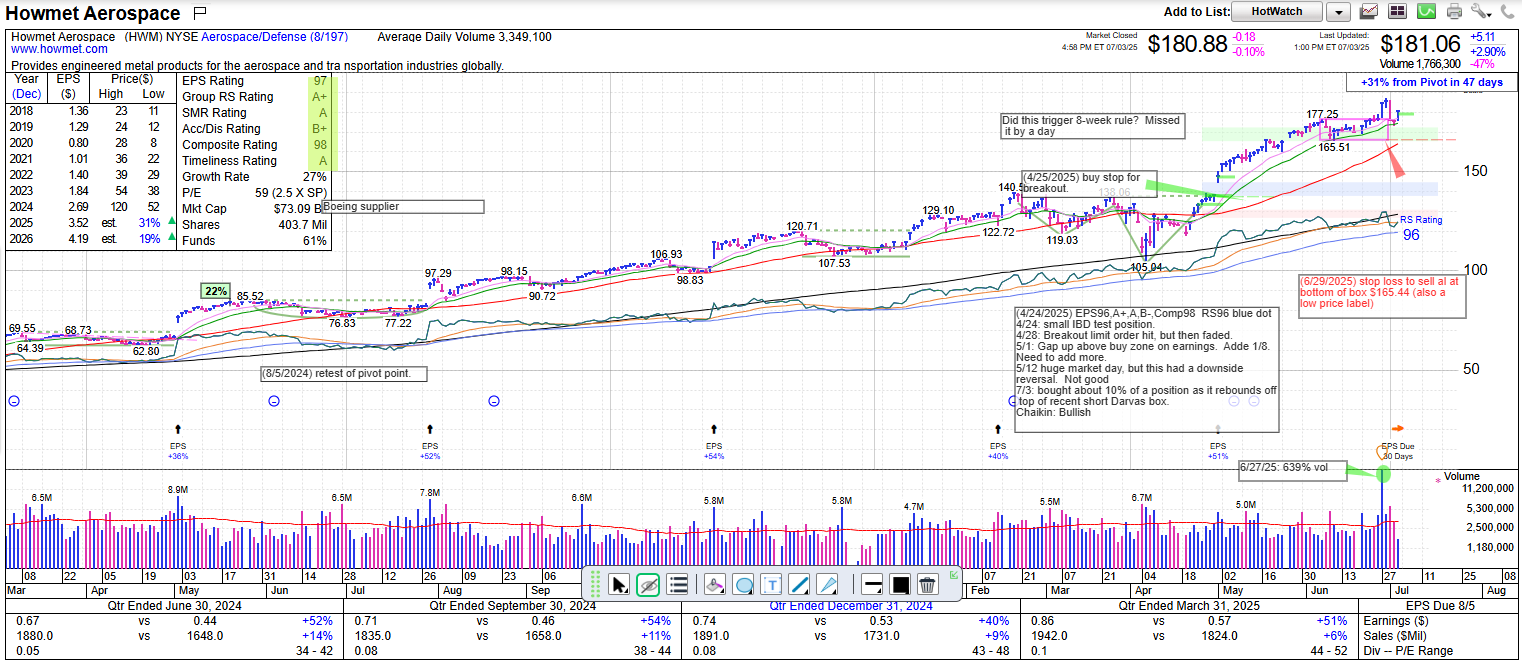
Some of my stocks have made good runs, as has the market. I am using short Darvas Boxes to add a little, but also to set a good stop loss for all shares. In this case the 400%+ vol day was very recent and I am hoping this propels the stock to pyramiding opportunity. They supply specialty metals for aircraft, hardly the thing the public and investors would think is going to change the future.

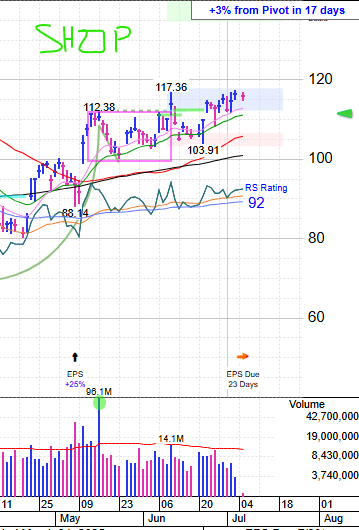
Is this a Darvas box on the SHOP chart. (SHOP has three 400% vol days on the chart, one shown in snippet below.

The box I drew meets the 3 week minimum. It seemed to have a breakout that day it hit $117.36, then it headed down but never went below the box floor. Price is now staying above the ceiling. I don’t know how much the price needs to go up to start a new box. Can the floor of the new box be below the ceiling of the current box? My sense is that it can’t be, because that is a sign of weakness and you wait for a higher box to form.

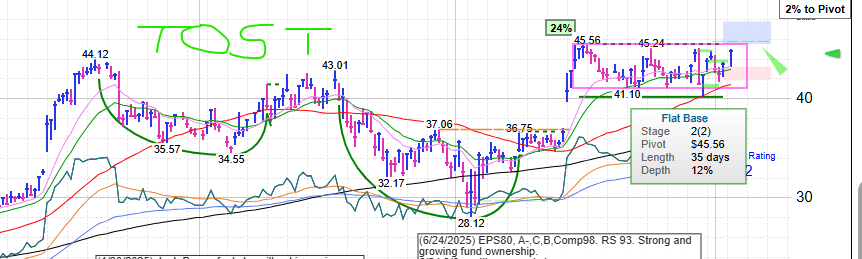
TOST has a valid Darvas Box whose ceiling coincides the pivot point. Market Surge sees it as a Flat base of 12% depth. I have a few early buys and a buy-stop for the breakout. Near 52 week highs. No 400%+ volume days, but one that was 388%.

Is this a stop people see as changing the future? Not really. It is not a glamorous consumer stock, but it is the best in class restaurant FinTech system. Start with point of sale, but they have add-on components that restaurants tend to add on. Those PDA’s the waiters use to take your order, scan your card and provide you an easy way to tip, are from Toast. I think they have other add-ons like table management, reservation management, inventory management.

2 Likes

Here is one for you Pete. I bought today at the bottom of the box. Might not be a smart move because it went below the box today. Going to wait till the end of the day to see where it is at. Podd

1 Like

Here is another box Pete, AS

1 Like

Andy, AS looks great, PODD not so much. I am trying to play with Darvas by buying the breakouts and he liked 3-week+ boxes with around a 10% depth. Similar to 3-weeks tight or a 5-week flat base in IBD/CANSLIM. AMER sports is perfect in many ways: nice, tight consolidation after earnings gap. Finding support at the 21dma just below top of box. Gap up was +347% volume and it is at 52 week highs. I will add my alerts, thanks.

I am a Darvas lightweight and relied on internet summaries. There is a lot of nuance and ambiguity I don’t know the answer to. Supposedly Darvas would wait for the box to form over 3 weeks or more before entering the buy-stop order. I think it is a hard rule about when the top and bottom are set, and that has been early on in my observations. In the AS example, I think that $39.17 “breakout” was right on the 16th day if I can count. So, Darvas would set the buy stop the night before and bought it at that point. I guess I should redraw my box to show the box ending there. Given that the buy signal already occurred and there was another breakout, it should be ok to buy today, as if you already owned it from the higher price. I guess! Ok, the slightly more prudent thing to do would be to wait until it breaks out again, or moves above the $39.17 label, or moves above that high near $40. These days, IBD folks would buy on a good move above the 21dma, which would also mean a move above the ceiling of the box.

Don’t know, just thinking out loud.

For PODD, you were not making a Darvas trade, you were cheating and hoping the floor would hold :wink: Darvas and Bill want shows of strength on breakouts before buying.

Darvas would invest in a company that was staying in a box. I do not remember him ever saying only break outs. As long as it was in the box he said sit on it. That is where his saying came from " I made more money from the sitting" :wink: While he did say breakouts past the top were a sign of great strength and a breakout past the bottom were a sign of great weakness I do not remember how far a drop he would allow. His book is a great read and I should probably read it again.

1 Like

Oh it’s not cheating to go into the trade expecting the box to hold, that is called an expectation breaker.

1 Like

I thought about this more Pete and I think my strategy was good but my implementation was poor. So I set the bottom of the box as my mental stop. That was good because it gave me a defined risk that kept my losses very tight. The bad part was I should have waited for it to bounce off the bottom and heading up. That would have given me a stronger trade and put me into the momentum of the trade instead of betting on the bottom to hold. I went back and looked at some other stocks with the same type of set up and it looks like the bottoms do not hold all that often. So when they drop out of the box what marketsurge does is rewrite the base of the box as the days progress. Valuable lesson, thanks.

2 Likes

Here is Podd on Sunday 7/13/2025. The software has rewritten the flat base to include friday’s drop.

1 Like

I think FTI has a valid Darvas box. 15 trading days. At 52-week high. Moved above box by a few cents Friday, but settled back in box. Depth of box less than 10%.

They also mentioned PAAS in the video and I notice a valid Darvas box there. 15+ days, at 52-week high and depth about 10%. In this case, it did violate the low of the box after it was defined, I and don’t know how Darvas looked at that. Was it a sign of weakness you would “never” see in a true winner he would buy, or is it a mild violation that had no impact on his thinking.

I have been reading more about the Darvas Box. They were the first iteration of patterns. Then Oneill came in and built upon his idea, finally Minervini came in and built upon that.

1 Like

Another thing I don’t know about Darvas boxes is when they officially start. I have been drawing them as starting when the official high point is set. That seems to coincide with the MarketSurge high-price label. IBD requires 9 trading days lower than a high to set the high label.

1 Like

Andy, thanks for AS, I just bought it on breakout above a real Darvas box, stop loss at bottom. Unfortunately, did not use a “Darvas” buy-stop, so got it at current high price.

For a swing trade, I bought DAVE off a rebound off the 50dma. Stop loss below the line.

1 Like

Does a box still count if it had a failed breakout? I think it should. As the story goes, Darvas would telegram in his buy orders after reviewing the weekly paper. That first move would have triggered a buy. And, as the story goes, at that time of the buy, the broker was instructed to put in a sell order below the bottom of the box. So, if Darvas had bought this, he would still own it on that second attempt (today), therefore, it would be valid to make my first buy on this attempt. That said, this stock is not near 52-week highs, so he would have not sent in the buy order. But it is a valid question if the 52-week criteria was met.

This is SBUX in my “value/turnaround” account, seems like I should buy some more.

1 Like

So when does a Darvas box start? I have been starting when the official high is marked, but I don’t really know the rule. In this example, I found the high, then expanded the box to the left until there were no bars that would fit in it. The low exists too, so that may bias me. If Darvas boxes need 3 weeks to be official, those extra days are critical.

Yeah, this is just a dalliance, but once I get interested, I want to know stuff.

(FYI, this is INSM, a stock you might want on a watchlist)

Jabil $JBL has a 3-weeks tight pattern on weekly, which also makes it a classic Darvas box in the 52-week highs area. It also has a lot of ants. JBL makes electronics and has been benefiting from the AI datacenter super-cycle.

2 Likes

I started experimenting with Darvas Boxes a while back, and what stood out is how clean the breakout signals can be—especially when volume confirms the move. It’s not a magic formula, but it helps filter noise in sideways markets. I usually pair it with a trailing stop to protect gains, and so far it’s worked well on momentum stocks with tight consolidations.

@embertmorton200 thanks for the post. I a lot of my previous posts, I have questioned myself and wondered about the ambiguity of the “rules”, so I wonder how you are implementing the rules.

Do you wait for a 3-week box? I have traded what I call “short’“ or “fake” Darvas boxes.

Darvas seemed to like a tight box, maybe 10% deep or so.

He also seemed to focus on stocks near 52-week highs.

One thing I haven’t found a rule for is “when does a box start”. You get a run up and then the stock rests and forms a box. But what is the first day of the box? Is it retroactively when the high was set? Or is all that days before the high and low are set as long as those days are not above or below the fixed high and low?

What if a high and low are set, but we are only 10 trading days into the box and it is breached on the upside? Does that nullify the box, or are we supposed to wait until the 15 trading days? Or are we supposed to buy that on day 10? What about if it is day 8 or day 13? Where do we draw the official line if not day 15?

A lot of these questions are shown in charts above, so if you have found solid answers, please let us know.

Pete

1 Like

$NFG seems to have a good Darvas box that coincided with and IBD base

This started the box on that gap up day. I saw Mario Gabelli on CNBC and this was his holding he was touting. Smart guy, so clearly a lot of people bought. Those who have waited now have the opportunity to buy it on a breakout when it “proves” itself.

It looks like the Darvas high and low were set on the same day. The bottom of the box has been violated, but not by much. I am not sure what the rule is on that. Since I can’t find that detail, I am guessing his book did not have it, but I have not read the book.

1 Like