Howard Marks is a respected value investor… interesting take…
3 Likes
Andrew Sorkin thinks there is, in fact he’s quite sure of it. That said, he has no idea how long it will last or when it might deflate.
“60 Minutes” had an entire segment interviewing him last night; here’s a summary:
5 Likes
Well, when you are promoting a book you wrote about 1929 crash, you have to draw some parallel to today and how or why it is relevant today… setting aside that,
For all the talk about AI bubble, the funny fact is, the AI companies like OpenAI, Anthropic, Perplexity, etc… have only raised private money, have not taken debt and they have not even came public…
My view is simple, the market is rallying and I have to stay invested. When it gets to “twilight” zone, I hope and pray I will have the wisdom to step out. I am working on few strategies to hedge and hopefully when it is time I will be able to execute.
I am not being flippant, rather completely sincere, my worry is what if there is a market melt-up, and the market rallies another 30%, 40%, even 50%, while I’m sitting on the sidelines?
5 Likes
While many are worried about AI, tech, and not many talk about the valuation of Costco and WMT, at 50, and 40 PE…
1 Like
Are you certain that’s a fair statement?
What is Microsoft’s (public company) investment in OpenAI?
Don’t microsoft and other public companies have exposure to these private firms?
2 Likes
That is not same as investor buying shares in IPO. We should view this as Microsoft’s cap-ex… Also, remember, $MSFT investment involved mostly Azure credits than hard cash, and $MSFT makes $100 B in profits and they can easily absorb, heck even write-off $10 B.
True, but not what you wrote.
Many public companies have economic exposure to private AI companies.
When $MSFT makes an investment in a pre-IPO company that is a private investment. $GOOGL and other tech companies have been investing in other startup’s for a long-term. $MSFT investment is no different.
Also, having economic exposure to private companies is pretty common. But OpenAI deal with $ORCL, $AMD are much more than regular “economic exposure” with partner companies or companies in the ecosystem. I understand that…
Listen, I present some data, but if you want to believe that we are in the midst of a bubble, I am not going to change your mind. Rather, I see all this skepticism, as a positive sign.
I saw the Saul crowd make that mistake with the SaaS boom. Even I did. I kept wondering if I should take my unreal gains, which put me WAY ahead of my investment schedule (nearly twice ahead) or keep listening to the “this time is different” mantra. I did get out but only after losing a third. Many there left two-thirds. Having the wisdom to step out is hard.
There are two ways this busts. One is suddenly, fast dramatic. Leaving you little time to react. The other is slowly, slow enough that you keep telling yourself “this is the bottom now”. (that is what the SaaS drop felt like to me).
Hint about AI: this time is not different either.
I want a 50% portfolio gain over the next 6-7 years. I don’t need home runs, and cannot afford steep losses. I’m sitting this one out.
5 Likes
Let me throw couple of additional things that should be scarring investors:
- First Brands bankruptcy fallout; An auto-parts company going down and causing write off over $4B so far, and the company has liabilities anywhere between $10~$40 B
- Friday’s Crypto wipe-off, $19 B lost, and 1.8 M crypto retail accounts were liquidated. Primarily driven by leverage, and crypto exchange shenanigan’s
1 Like
I don’t know what happened, and what mistakes were made. I have risk management rules in place for my portfolio and follow them to a greater extent and my overall portfolio is very diversified, except for one name, where I have significant concentration risk, but I cannot sell without incurring significant taxes. I have to rely on hedges for that 
We are not there where the market is so stretched it could suddenly drop. Often, a melt-up precedes before such crash.
Been there… today I am better equipped mentally, financially, and have strategies to deal with this kind of decline.
That is about 8% return per year… that means you have to be invested and stay in the market. You cannot sit out.
3 Likes
The “bubble” talk is itself a bubble. Everyone everywhere is talking about “AI bubble” daily.
There are Trillions of $s parked waiting for a crash or correction. This pile keeps on growing. It is easy to very easy to scare people.
Meanwhile, AI use across the globe is increasing rapidly.
Direxion Daily S&P 500 Bear 3X Shares (SPXS)
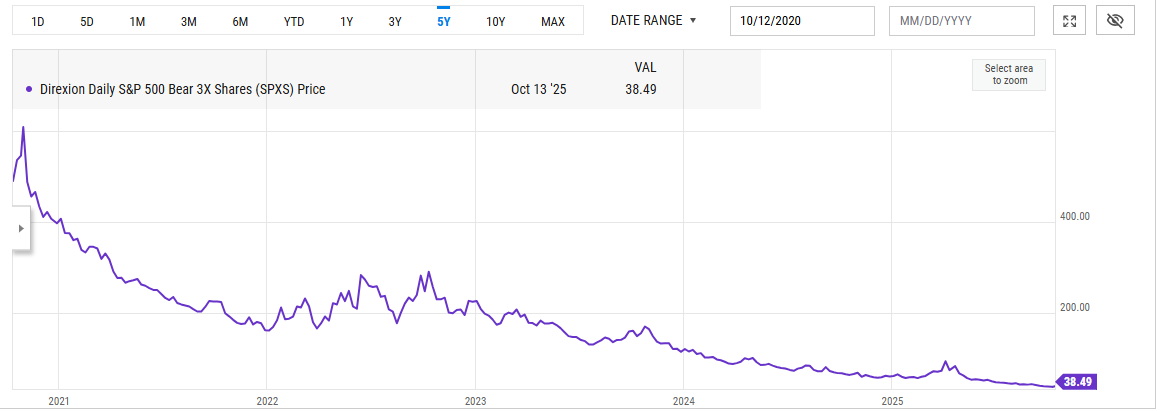
Having said that, if you cannot handle 40% drawdown tomorrow, you should not be in the stock market.
Interesting commentary but I think it misses the central point. You cannot go broke as long as you can pay your bills.
Back in 1929 brokers were lending money to speculators with no regard for margins pushing up prices as predicted by the Law of Supply and Demand. At some point a Black Swan scared the market and unleashed a Chain Reaction until much of the margin loans were settled.
The current investment in AI is not dependent on margin loans. That is not to say that all AI investments are risk free. To repeat myself, figure out which companies will be able to monetize their AI investment.
The Captain
6 Likes
Yeah, Andrew Sorkin was on “60 Minutes” on Sunday night saying there’s definitely a bubble. Here’s one this morning in the NYT (gift link)
We believe it’s time to call the third bubble of our century: the A.I. bubble.While no one can be certain, we believe this is more likely the case than not. Investment in artificial intelligence has been so huge — with venture capitalists investing nearly $200 billion in the sector this year alone. Additionally, data-center investment has tripled since 2022. Together, these investments are driving growth across the entire economy, pumping up the stock market and generating increasingly eye-popping valuations of the technology firms driving the A.I. revolution.
In financial markets, a bubble occurs when the level of investment in an asset becomes persistently detached from the amount of profit that asset could plausibly generate. While investors are always making bets on an unknown future, bubbles form when large swaths of investors continuously pour ever more into an asset, with seemingly little regard for how much it could earn and when.
A.I. investment fits that pattern. OpenAI [says it needs](https://www.wsj.com/tech/ai/ai-bubble-building-spree-55ee6128?mod=author_content_page_ at least $1 trillion to invest in data centers that provide the electricity, computing power and storage to train and run A.I., yet the company’s revenues are expected to amount to a mere $13 billion this year. And since the debut of ChatGPT, an easily accessible A.I. chatbot, in late 2022, the S&P 500 has swelled by nearly two-thirds, with just seven firms — all of whom have invested heavily in A.I. — driving more than half of that growth.
3 Likes
But I can sit out the AI names, and stay in European equities for the time being. The stock market is big, with lots of choices.
6 Likes
The US market is about 60% of the world market. If US catches cold, you are going to sneeze everywhere. From your words it seems you are not yet in EU stocks, and they all had good run this year… just saying, you may end up chasing there too…
We don’t like Jim Cramer but love Andrew Sorkin. At least Jim ran a Hedge fund, and still overall a better stock picker. Many democrats made fun of him, but that is anguish of a man, who is seeing big business are going out of business and government could save them, his friends are losing their jobs… You can disagree with his stock pick, but…
My people have been in this game for 25 years and they’re LOSING THEIR JOBS and these firms are gonna GO OUT OF BUSINESS and he’s nuts. They’re NUTS! They know NOTHING!
I don’t know why I am posting on this thread. The ONLY thing I have in common with Warren Buffett in investing is my total inability to guess when a bubble will stop inflating, when it will pop, when it will bottom, and how long it will take to recover.
I don’t talk about it much here, but I still follow the ‘sleep at night’ rule. When assets appear to me to be severely overpriced, as they appear to me now, I let my cash accumulate and I let my stocks that I do not need and will not need over the next decade, to run up, down, sideways, until I see a real shakeout that enables me to deploy that excess cash. In 2022 I waited for the crash to fall an arbitrary 20% or so by June or thereabouts, at which point I started taking SS and dollar cost averaging my monthly checks into a few ETFs. I recently stopped dollar cost averaging my SS checks into my ETFs and also stopped reinvesting some of my dividends to grow my cash while my stocks ride this bubble up, down or sideways.
I also moved a chunk of money from my 401(k) last March, hoping to take advantage of a drop in prices.
Enough money invested to take advantage of multidecadal trends, and enough cash to survive a long, sustained crash.
My recent reallocation toward international stocks has not changed my returns much. They sometimes zig when u.s. stocks zag, but overall the whole world seems to run in tandem with the U.S. my international bonds seem to be holding up somewhat.
8 Likes
Goofy, et all, consider this simple fact, US companies are doing give or take about $1 T in buybacks annually… Let it sink. How much is the AI investments in a year???
I thought we all wanted companies to reinvest the profits in the economy and in growth, right?
I considered this option and eliminated. The investment grade bonds anywhere is not paying more than 5%. That can be easily wiped out by a slight move in USD. If you are investing in international bonds, you are hoping currency is going to be in your favor.